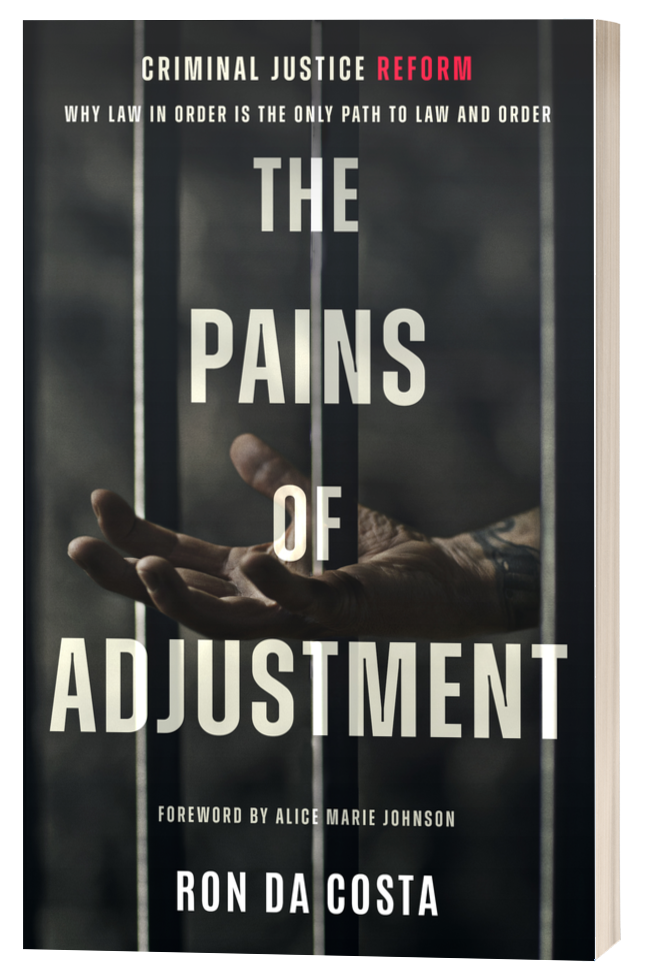
These chapters contain some accounts describing a look inside my host country (Denmark), where I was way more committed than they expected. When it comes to Law and Order, Justice is dynamic/fluid. Each country is different; one focuses on their cultural ideology, another on profit and another on their image. What they all have in common is that political self-interest is an overriding factor – someone or a group is benefitting from the status quo; “no one is above the law” is a myth. Personal “political self-interest” is the rule of thumb. This is akin to hypocrisy.
Why are re-socialization and rehabilitation projects/programs often unsuccessful???
The only reason why these programs continue to exist is because, besides puffery, they have well formulated plans and the intentions are always honorable. In addition, very little focus is placed on their actual efficacy since they are often able to present their audience with some kind of one-off success story.
“Ron says: He understands their INTENT based on their INTENTIONS[1], but he argues that their vital practical processes and procedures are not INTENTIONAL.”
[1] The phrase “the road to hell is paved with good INTENTIONS” suggests that good intentions alone are insufficient; without proper actions, they can lead to negative outcomes.
Let’s be clear, this is not about a country but rather a system. Those who govern my host country are all concerned about their political image. The best description of a worldwide phenomenon that I came across regarding THE SYSTEM is: A nation of sheep ruled by wolves owned by pigs; “justice for all”, the question is whose ‘all’ are they referring to? The owners (the 1%) cut deals, the wolves (the politicians) divide and slaughter (not conquer) and the sheep are the people. In my opinion and experience: Their correctional and judicial system will ignore or downplay facts to preserve IMAGE locally as well as globally. Their solutions are cosmetic at best, inclusive of contrived data all depending on the goal. They, like many others, are not committed to the task of resocialization but rather securing their jobs.
More justice is found in the tribal construct, where it is about the survival of the group, where people wear no shoes and cover their bodies with natural objects, everything is shared so that the roles of their society are absolute. Here you find justice in the form of wisdom and traditions – often guided by nature and not social construct.
A SYSTEM IN DISARRAY.
“As muddy water is best cleared by leaving it alone, it could be argued that those who sit quietly and do nothing are making one of the best possible contributions to a world in turmoil.” ― Alan Watts[1].
The art of trivialization. You thought that I was an interloper for exaggerating or unjustly criticizing those who cling to the old cliché, “If you don’t like it here, you can go back to where you came from,” a common phrase used by Danes towards outsiders which does not solve any problem! The Danish prison system is at a precipice. Prison and Probation Service’s ‘Exodus analysis of prison officers 2017-2018’ maps out why employees resigned and paints a critical picture of the prison system as a workplace. In part, 68% answered 103 surveyed officers in a questionnaire that they stopped mainly due to widespread frustration amongst guards, exhaustion, cutbacks, and lack of confidence in management. Prisons and jails are overcrowded and violence against employees is getting worse and rising year by year. In a series of articles, Berlingske Tidende (a major national Danish newspaper) uncovers the conditions in the crisis-stricken Danish prisons and detention centers – supporting the saga I have been describing. Parliamentarians had compelling and harsh criticisms after the newspaper obtained important “classified” analysis reports. In a series of articles, Berlingske uncovers the conditions in the crisis-stricken Danish prisons and detention centers.
On Monday, July 13, 2020, ‘Berlingske’ published a breaking news article entitled, ”Political parties criticize Thorkild Fogde (National Police Chief) for not having received an alarming analysis on prison guards’ exodus” (”Partier kritiserer Thorkild Fogde – politiets øverste chef – for, at de ikke fik alarmerende analyse om fængselsbetjentes afgang”) in which they got hold of analysis reports that were intentionally withheld.
Though I found many strategies and claims highly questionable at my arrival in 2010, the department’s pivotal period (between 2016-2019) is where the downward trend started to noticeably exacerbate. This reaction was most likely partially triggered by a 2015 zero tolerance policy that was put into effect. Following this flawed policy, the then Justice Minister Søren Pape Poulsen and the Director of the Prison and Probation Service were not the right combination for the task at hand. They were not qualified to handle the critical development that was taking place at the time. They made consecutive poor decisions based mostly on politicos with no vision. “Help me choose the harder right than the easy wrong”; words I bet the Minister is unfamiliar with, as he put out fires with gasoline. Employees and inmates alike helplessly experienced the negative results of those decisions. Resocialization got lost in the smoke in what was becoming an employee stand-off (employees frustrated with management). Formerly withheld key analysis documents shed light on how Parliamentarians were obstructed from doing anything about what was transpiring.
The former Director of Service – now the National Police Chief – is embroiled in a political shitstorm. Several parliamentary legal spokespersons accused him of withholding a valuable analysis report from political policy makers that drastically diminished and delayed their capacity for taking appropriate action in the case of the prison guards’ exodus. According to critics the information was not made accessible for approximately half a year. The report that Berlingske had in its possession dated back to 2019. It was not made accessible until July 2020, after his departure. In my book, I discuss how they cover themselves by rewarding “loyalists” with high positions and switch job titles to obviate facing responsibility for bad conduct. The unraveling of certain wrongdoings is only revealed when a new political party takes over the government. The analysis findings were first sent to the parliamentary legal committee in July 2020 after Berlingske asked The Justice Minister, Nick Hækkerup, to address these alarming results. This situation was deemed quite reprehensible by parliamentarians.
According to legal spokesperson, Karina Lorentzen Dehnhardt, “The National Police Chief, who from 2017 to 2020 had the ultimate responsibility for the prison system, left Service shattered.” She goes on to say, “I believe, the departing analysis of Thorkild Fogde puts a stain on his CV. He withheld and hid how critical things really were. This was extremely important information for politicians.” “He should have told the politicians that the Prison and Probation Service risks collapse. While we are doing nothing, people are breaking down and inmate progress is stalled. In that way, we risk in the other end new victims when inmates are let loose in a worse condition than when they came in. Thorkild Fogde has not solved the exodus crises, and he has deprived the politicians the possibility of demanding action – because they were not informed.”
Legal spokesperson, Rosa Lund, formulates her critique this way, “Thorkild Fogde should not hide such information, because then we politicians have no chance of taking care of the ones who are looking after those of us living in Denmark. It is worrying that he now has another top position, where he is also in charge of other people who also have a demanding job.”
Kristian Hegaard (another Parliamentarian) cited that it was “very strange” that the analysis was not presented for political consideration. Though he emphasized that he did not know whether the decision was made by Thorkild Fogde, he therefore had no basis for directing personal criticism against him.
The chairman of the prison association, Bo Yde Sørensen, was also very uncertain about whether Thorkild Fogde or the Justice Department withheld the analysis or who obtained it. But he stated that criticism must be leveled at those responsible. “It is deeply criticizable…”, said the “chairman”, who goes on to say; “We cannot do anything about the Prison and Probation Service’s staffing problem if we are not able to discuss it. Therefore, it is catastrophic that an analysis has been prepared that shows exactly where the flaws are and how they were hidden away.”
To no surprise, the new national police chief, Thorkild Fogde, did not comprehend the critique from the different parliamentarians. He gave several justifications regarding the different meetings that were held at the time with different departments. He also stated that in the fall of 2019 all analyses were forwarded to the relevant Ministries and other departments. This is astounding to me, I guess this means the chief can wash his hands of the criticism.
Furthermore, Fogde stated, “I am surprised of the critique – seen in the light of the conflicting situation – between the heavy rise in the numbers of inmates on the one side – and on the other, the snags with getting sufficient numbers of recruits and keeping those already employed – which was a main theme on the agenda those years – and probably still are.” In other words, he left behind no legacy since the situation took a turn for the worse on his watch. He further explained, “For sure, there has been no wish from my side to keep secret the fact that the Prison and Probation Service has been in an exceedingly difficult situation regarding staffing.” It is never anyone’s intention of doing anything wrong until the press gets hold of it. Thorkild Fogde says he does not know what happened to the analysis after he took over the job as National Police Chief. Ah, the convenience of leaving muddied water alone. The article concluded with the current Justice Minister (Nick Hækkerup) saying, “The responsibility in this case lies with me.” When asked why, He answered, “Because I am the Minister.” Anthony T. Hincks once said, “Who wins from a world in turmoil? Those who back both sides. That’s who!” Seems that the Minister has his political game down.
As an interloper, I could not have said it clearer than their own parliamentarians. These sentiments were echoed throughout this autonomous prison culture. It seems that the Prison and Probation Service Director did not fit into this culture. Critiques within the culture ran rampant during his tenure and that of the then Justice Minister. “Following Berlingske‘s inquiries about the exodus analysis, the Ministry of Justice has sent it to the Parliament’s Legal Committee, and the Prison and Probation Service has chosen to publish the material.” –Berlingske, Journalists JENS ANTON BJØRNAGER and JENS BECK NIELSEN, July 2020.
EXCERPS FROM THE ACTUAL ANALYSIS
Article: “Alarming report reveals the reasons behind prison guards’ exodus: “Danish Prison and Probation Service are on a catastrophic course.” (”Alarmerende rapport afslører, hvorfor fængselsbetjente forlader jobbet: “Kriminalforsorgen er på katastrofekurs”)
103 prison guards tell in a comprehensive internal investigation[2] from the Prison and Probation Service why they left the job. The 103 surveyed guards cited the primary reasons for resigning: Lack of development opportunities (60 percent). Economic cuts (60 percent). Lack of time for relational work (56 percent). The salary (55 percent). Emotional exhaustion (52 percent). Lack of trust (51 percent). The study was completed in 2019 but was not published. Berlingske was refused a request for access to it on the grounds that the analysis was not for public consumption. Berlingske’s creative initiatives yielded possession of the material, which painted a harsh picture of the working conditions for Denmark’s prison guards.
58 prison officers who resigned were heard in interviews lasting 30-90 minutes. Many of their bitter experiences were highlighted in the analysis. Overall, they testified to huge frustrations such as: “We got braindead target assignments that were not well thought through.” “You had to reduce the amount in reports of violence and threats down to three, which resulted in people not reporting.” “My main reason for resigning was that I, as a leader, had to compromise so much with my own values and human views, this in order to be able to solve tasks. The distance became greater and greater between employees and inmates. Before, you had more time to be on the ward, but now it is just putting out fires all the time. You lose contact with the people you are dealing with. […] You forget a little bit what it is you are working with, namely people.” ”Frustrations amongst staff trickled down onto the inmates, lack of focus on our core task.” “The concept of civil servant means that people are not fired, even though they should be. Several people are gutted but cannot see another way out. They have reached an age where they dare not learn anything new. Then you really just get stuck and have a negative attitude to it all.” “I was psychologically affected after some assaults on myself and my colleagues, and I have helped to cut down two people who were hanging in the cells.” says another officer, “One was dead, the other, we resuscitated. It was often when we opened the doors that something happened. I have experienced an inmate trying to throw boiling water onto my head […] another inmate smashed a mirror and stuck out after me. […] I was always at the forefront when we had to have a discussion or deal with an inmate, because I was good at it. In step with the many unpleasant experiences, I often withdrew and felt that I was failing my colleagues and not backing them up as I should.” ”The emotional stress affects you the most. You cannot see it yourself, but your family and friends see it. I became more and more antisocial. There were many things that came into play: The shooting episode in Nyborg (a prison officer was shot outside the prison in July 2016) made an impression, and a colleague was pursued on his way home from a shift by members of the Black Army gang and felt violently threatened. He never came back! “
Many parliamentarians responded that the conundrums within prisons will result in major setbacks for society outside prisons. Legal spokesman Kristian Hegaard remarked, “When I read the study, it is first and foremost clear that the officers are not given the opportunity to work to ensure that the inmates do not commit crime again. It is a disregard of the officers’ professionalism and a failure towards future victims.” Spokesperson and deputy chairman Inger Støjberg called the study an eye-opener about how prison officers performed an extremely important societal task under difficult working conditions, “You can no longer turn a blind eye.” The investigation raised concerns about whether the Prison and Probation Service could lift the core tasks; keep criminals imprisoned and limit the inmates’ recidivism to crime after release.
Minister: The problems must be dealt with.
When asked directly, Minister Nick Hækkerup answered that he did not know whether the decision to withhold the analysis was made in the Prison and Probation Service or the Ministry of Justice. In reference to the anonymity of the participants he said, “If you were zealous enough, you could find out and identify who it is. But I will anonymize/redact it and send it to Parliament.” He was also asked if he thought that the analysis should have been published. Hækkerup replied, “I can understand the consideration that one should not risk that people who have participated in the analysis and have been told that it is anonymous can be identified. For that reason, I think there is a confidentiality consideration, but I think on the other hand that the analysis is so important for the discussion about Service that the messages in it should come out.” “At least it is a picture that confirms that we have a penitentiary system that is not where it should be and that something needs to be done about it – there are massive problems that need to be dealt with.”
Berlingske asked Service to explain why the analysis was not published, and (if part of the argument is that the interviewees were promised anonymity) why it has not been possible to anonymize their statements? In a written response, dated July 2nd, 2020, Service explained that the analysis was not intended for publication and that it is due to participants having been informed that their answers would remain anonymous so that they could express themselves freely. Considering the public interest that there has been for the analysis, it has been decided that it will be published this week. This is noticeable in an edited form, which considers the people who have participated in the analysis”. – Berlingske, Journalists JENS ANTON BJØRNAGER and JENS BECK NIELSEN, July 2020.
INFERENCE. How can Denmark boast of a well-functioning prison system that other countries could consider emulating when the neglectful public officials are responsible for securing a system that provides an environment where prisoners can find new direction, while assuring the public that all the official duties have been fulfilled? Seriously, the mere fact that the integrity of these politically appointed public officials is in question speaks volumes.
Lack of confidence. Why does any such document need to be withheld from the public (taxpayers) and why should the staff speaking out have anything to fear? Management and leadership throughout government sectors from public service to law enforcement has largely created a smoking mirror that will do ANYTHING, even cover for each other, to avoid public scrutiny. The way in which they get away with bad behavior is as Bob Dylan said, “To live outside the law, you must be honest.” Instead of zero tolerance for “criminals” we might want instead to reconsider a zero tolerance for public appointed officials. This would send a clear signal, that when we hold our officials accountable, what do you think we would do to you the “criminals!” The articles have indicated a willingness by prison guards to participate in the re–habilitation efforts. The Prison and Probation Service will not be able to make things better when transparency is intentionally suppressed. In addition, as I have strongly alluded to that more adequate training is necessary. How convenient for politicians and management to sit back and opt for more tough on crime policies when it is the guards who are left to carry out these procedures. There is a big difference between fighting fire with fire and adding fuel to the fire. When warnings remain unheeded and you do not remain critically vigilant, rather than neutralizing the recidivism factor, the Prison and Probation Service can and is instead becoming a breeding ground for a more hardened prison population. In addition, causing a rise in your recidivism numbers even further while predictably exposing society to what could have been avoidable perils.
Teachers overlooked. Not mentioned in this whole saga is the exodus of schoolteachers for many of the same reasons. The uprooting was so bad that even the inmates wanted to leave with the guards and the teachers. I asked several teachers who left the prison ‘Vester Fængsel’ before and during the years in question to send me their reasons for resigning.
The teachers’ responses summarized: A myopic approach to work with the uniquely challenging prison population left me without the extra pedagogical tools I needed. It was about trial and error, which led to a lack of confidence. You are given the wrong impression to start with regarding expectations. Words like ‘zookeeper’ were used to describe their work. Work environment totally lacking ambition, no inspiration, no drive and no creativity. Teachers were left to figure it out for themselves; you were hired for one thing and ended up doing something totally different. Sometimes things you were not even hired for – you had to improvise all the time. Leadership was poor and out of touch, had no clear direction and many things were left to coincidence. Some felt controlled yet given little to no acknowledgement by top management. Resocialization did not seem to be a priority, with no pedagogical strategy. Teachers lacked the skills to navigate in the different systems, codices and subcultures that make up the inmates’ realities. Proposals fell on deaf ears; dynamic security was totally neglected for a harder line. As a teacher, my hands were pretty much tied, the school always got the short end of the stick when it came down to new regulations.
CUFFED AND MUZZLED.
An addition to why the autonomous environment of Service is (or can be) enormously frustrating for the staff as I will refer to later in my narrations under: “CORRECTIONAL OFFICERS TRAINING AND THEIR ACTUAL ROLE.”
Excerpts from another Berlingske article 2020: Employees plea for having “influence on when they can have holidays with their family” – Service responded with fines and reprimands (“Medarbejdere bad i nødråb om »indflydelse på, hvornår vi kan holde ferie med vores familie« – Kriminalforsorgen kvitterede med bøde og irettesættelser”). Service responded with sanctions when senior employees raised internal criticism of conditions in the workplace. Legal experts call the sanctions unjustified. The Chairman of the Prison Association criticizes that the management puts a muzzle on employees. This was made clear when four senior employees raised internal criticisms of workplace conditions and were punished. The Prison and Probation Service is willing to go to great lengths to quiet critical employees. This, generating a backlash, which according to legal experts was unjustifiable, a group of leaders from the detention centers, in a case dating back a year or so, where an internal e–mail circulated an “alarming plea”, about criticizable working conditions to the Prison and Probation Service’s management and to about 70 colleagues. “The leader who had sent the email was served a fine of 1/25 of his monthly salary. The three other leaders who co-wrote the email were reprimanded.” Sanctions and intimidation; this is some real “Original Gangster” style stuff if you ask me.
Sten Bønsing, Professor of Administrative Law at Aalborg University, sees no reason for that punishment. “In my opinion, it is unjustified that you are sanctioned for telling management and colleagues that you are under tremendous pressure. I would claim that you can write it on Facebook if you want”, says Sten Bønsing: You can write and say whatever you want – unless it is confidential. And it is a general misunderstanding that you reveal something confidential by stating the obvious through informing that the situation at your workplace is unsustainable. We can almost wallpaper the walls with statements from the Ombudsman.
Rikke Krøger is working on a PhD dissertation at the Department of Law at Aalborg University on the responsibility of civil servants and the sanctioning of civil servants. “As a public servant, you have freedom of speech and thus the right to criticize your workplace and the policies practiced there. That is why I would go so far as to say that the sanctioning of the statements in the e–mail may be in conflict with the freedom of expression”, says Rikke Krøger, and adds: “It is completely unusual for such a case to be sanctioned.” “It compromises neither the security of the kingdom nor the Prison and Probation Service.”
Cat and mouse (the art of equivocation). The Prison and Probation Service’s management first responded to Berlingske‘s inquiry about the sanctions with a written quote from HR Directress Lene Vejrum who had the chutzpah to message that “we cannot go into a specific personnel case.” Here is where she pulled out the violin, “The right to speak is a fundamental right, and therefore it is generally very important for us that there is openness and responsiveness to employees’ experiences and concerns in relation to their workplace”, the HR Directress said in the written reply. Subsequently, the HR Directress set up for interview: Lene Vejrum, if the right to speak is a fundamental right, then why was the leader in question fined for writing an e-mail with an alarming plea?” There I unfortunately have to say that I cannot comment on the specific personnel matter. But I stand by my statement, “says Lene Vejrum. You are a lawyer yourself – does the Prison and Probation Service have the law in order when you sanction four senior employees for writing an e–mail with an alarming plea? “I have to say that I cannot comment on the specific case.” Is the real problem that the four leaders undermine the Prison and Probation Service top management authority by sending the email around to, among others, 70 colleagues? “Again: I cannot comment on the specific case.” We stopped the interview, but Lene Vejrum indicates that she wants to add one thing: “It is also important to us that there is openness and that we are responsive to the employees’ issues and that they can come to the management when they have something on their mind. It is also important to us.” emphasizes the HR Directress. When this is important to you, then why were four senior executives punished with penalties for writing an alarming plea? “And there it is that I have to tell you that I cannot comment on that, as it is a concrete personnel matter.” – Berlingske, Journalists JENS ANTON BJØRNAGER and JENS BECK NIELSEN, July 2020.
’What happens in Vegas, stays in Vegas’. You would like to believe that they would focus more on socialization rather than in-house squabbles. Sad to say, but a great deal of time is spent by this cat-and-mouse game, where people go to great lengths to avoid becoming embroiled in disputes simply for offering constructive criticism. Therefore, they simply resign or withdraw and become onlookers while others adopt the strategy of, “if you can’t beat them join them.” In my opinion, this is where the in-house promotions (A form of Peter Principle[3]) find most of their candidates.
BRACE YOURSELVES. Excerpts from another Berlingske article: The new Directress of Service: Case of fine and reprimands for sending ‘alarming plea’ with internal criticism must be reexamined (“Kriminalforsorgens nye direktør: Sag om bøde og irettesættelser for at sende »nødråb« med intern kritik skal genbehandles”). After Berlingske brought an article about a group of leaders in detention centers, who were punished with fines and written reprimands for raising internal criticism of working conditions, the newly appointed Directress of the Prison and Probation Service has ordered the case re-examined. The newly appointed Directress of the Prison and Probation Service, Ina Eliasen took up the position as the chief of the prison service on July 1, 2020. She came from a position as HR Directress of the National Police. She too metaphorically plays her violin. In all likelihood, a group of leaders in the Prison and Probation Service should not have been punished for sending an internal, alarming plea that criticized working conditions. This is quite a politically correct public statement!
The chutzpah. “I have specifically asked those who have made the decision to look at it again.” says Ina Eliasen. In an interview with Berlingske, she emphasizes that there will continue to be a culture of openness in the Prison and Probation Service. Ina Eliasen even encourages employees to express themselves in internal discussions. Isn’t that what this is all about? As proven, there was never an ethos of openness! So how can it continue? Well, it’s not going to happen, since they have the “fire wall” chain of command system I talked about in my narrations. She goes on to say, “I do not want to comment on the specific case, but I would like to say something about whether it is okay to criticize working conditions. And that is all right. It is also more than okay – we want our employees to do it. We heard those exact statements in cat-and-mouse, remember? When personnel go around with all types of thoughts, but the management does not get to know, then we cannot do better, “says Ina Eliasen. Comment: Question is, does this include thoughts that question or challenge management’s positions?
“In addition, we can totally disagree, which we sometimes will, management and personnel. But it starts and ends with being able to say things out loud; it is extremely important that we have this openness within the Prison and Probation Service, and this case should not hamper that.”
Bo Yde Sørensen (Chairman of the Prison Association) when the journalists spoke to him about this case said, “We have all learned not to say anything because the system reprimands you harshly enough that neither you nor your surroundings will ever forget it.” What do you think about that? “I noticed that Bo Yde said that, and I would like it not to be the image you have of going to work in the Prison and Probation Service. Again, we can totally disagree, which we sometimes will, with management and personnel. But it starts and ends with being able to say things out loud,” says Ina Eliasen. – Berlingske, Journalists JENS ANTON BJØRNAGER and JENS BECK NIELSEN, July 2020.
REFERENCE – You are bound and gagged. I am of the supposition that the openness authorities refer to allows management to sort out who they can trust; who fits into their autonomous ethos. They need to know where they have you. Hence, the signing of nondisclosure agreements with the intent to keep inmates and operational duties secure and to muzzle staff from exposing conduct unbecoming to a highly recognized government institution. This autonomous culture is all about making your management position relevant. As mentioned, people are doing “pseudo-work,” busy doing nothing, or if you follow Parkinson’s law, the adage that “work expands, with the intent of filling the time available for its completion.” So, when the in-house authority is challenged or feels threatened, management becomes defensive, to protect their jobs. W.C. Fields said, “A thing worth having is a thing worth cheating for.” In addition to that you have a well-groomed management, which applies the political art of sticking to the script, convincing you and the public that they are working with the best intentions. Unfortunately, a handful of wrong policies and poor judgement have made the Prison and Probation Service, which should be responsible for 1/3 of the resocialization solution, ineffective. So, replacing a director without overhauling the system will only delay the inevitable. Enough of the same old same old, the system needs to stop procrastinating; they need to acquire practical effective REFORM or REPLACE.
The writings are on the walls – instead of preparing for an expected inspection, or a visit by a Minister and his delegation to showcase the prison in a positive light, maybe it’s time to really use the opportunity to put the entire facility in order and not designated areas. Some effective resocialization efforts can simply start with the simple observation that in every cell there are writings on the walls that glorify violence and crime. These writings are left for lengthy periods of time (years). Inmates are left living amongst words such as ‘Mercy is a weakness’, or, ‘Shoot to kill’ and it only gets worse. Every toilet has written death threats – words that stick to your mind, just like we remember quotes or use positive affirmations hanging on the mirror. Does this create or inspire for a safe environment? Such a simple thing to fix and easily maintained once a cell is painted over, guards can easily detect new writing and act accordingly. This can be a good and effective place to start with your RESOCIALIZATION. “Afterall, you had DKK 200 million you did not know what to do with.”
SHARED VIEWS.
There are several similarities when you compare the neglect within some Danish nursing homes, preventive social programs and correctional institutions as my narrations imply. They all lack personnel with specified training. First and foremost, it must be said that this TV2 hidden camera report was approximately six months old and was first blocked by the courts in the city of Aarhus. It was Ekstra Bladet (a Danish tabloid) newspaper’s Chief Editor Poul Madsen who decided to ignore the court’s order, citing that it is in the public’s best interest to get this information out. Ekstra Bladet released the news to the public at large forcing TV2 to go public with the footage. He added that he was prepared to accept any backlash or consequences resulting from his actions. And if you recall, I cited another TV2 hidden camera disclosure of failures in day care within the chapter “Food for Thought.”
Danish TV2 hidden cameras inside nursing homes has opened a can of worms. With the title, “The façade behind nursing homes” (“Plejehjemme bag facaden”) July 2020.
Cameras are revealing that they can work for you or against you, even Service had at some point tried a body cam program. However, this was quickly abandoned… Nevertheless, this documentary reveals several forms of neglect going on in nursing homes. This time being within the dementia population. The reaction though, makes one feel as if this is the first time elderly issues of neglect have been exposed in the media. Once more, municipalities and government officials find themselves scrambling to address this embarrassment. Experts commented that it is mainly attributed to the absence of specific practical training and agreed that the system must invest in the expansion of education. Gunhild Waldemar Professor, chief physician, founder, and head of the National Information Center for Dementia talked of a more specialized education with the emphasis on the practical aspect.
Dementia psychologist, Anneke Dapper-Skaaning commented that she agreed with Professor Gunhild Waldemar and added that the current educational system should include a more comprehensive practical training where students get to rehearse real practical situations. She went on to say that you don’t want to address the requisite school training only because when the apprentice comes out to the workplace, they are met by senior employees who argue that they are used to working in a certain way. Moreover, they have done so for the past 20 years (habit) – creating a friction juncture between an ingrained ethos and an upgraded or different approach. Therefore, adding that everything and everyone in the workplace will need an overhaul. She also made a point of including management. Everyone must be on the same page, no exceptions.
Their proposals are nothing shy of the cogent arguments I have presented in my narrations, as to the expansion of the current pedagogical educational system. Just like dementia is a specific diagnosis amongst the elderly. So are specific behaviors amongst different stigmatized groups that also require tailored, practical methods that can be introduced as supplements to the current system.
“It is not the critic who counts; not the man who points out how the strong man stumbles, or where the doer of deeds could have done them better. The credit belongs to the man who is actually in the arena, whose face is marred by dust and sweat and blood, who strives valiantly; who errs and comes short again and again; because there is not effort without error and shortcomings; but who does actually strive to do the deed; who knows the great enthusiasm, the great devotion, who spends himself in a worthy cause, who at the best knows in the end the triumph of high achievement and who at the worst, if he fails, at least he fails while daring greatly. So that his place shall never be with those cold and timid souls who know neither victory nor defeat.” – Theodore Roosevelt.
[1] Alan Wilson Watts was a British writer and speaker known for interpreting and popularizing Buddhism, Taoism, and Hinduism for a Western audience.
[2] Service’s ‘Departure analysis for prison guards 2017-2018’.
[3] Laurence J. Peter, The Peter Principle states that, if you perform well in your job, you will likely be promoted to the next level of your organization’s hierarchy. You will continue to rise up the ladder until you reach the point where you can no longer perform well.
PROGRAMMED CORRECTIONAL OFFICERS.
Guards are just prisoners with benefits – they dictate after having been dictated to.
Falling in line. When describing the Prison and Probation Service, I often speak of an autonomous culture, the “do as I say, not as I do.” Nowhere else is this truer than when it comes to the handling of the prison guards by the system. If they do not already enter with this mindset, they will slowly but surely be herded towards that frame of mind. Your freedom of speech is met with a muzzle. This might account for some of the details described in this section.
Correctional officers (guards) are caught in a difficult situation. Once the police make the arrest and the individual is detained for sentencing, it is the prison guard who will deal with this individual daily for the next several months or years. While muzzled, they are expected to carry out the sometimes-unpleasant task of controlling and disciplining the inmates. They will complain about the working conditions amongst themselves, the physical and psychological pressures they endure, but will rarely speak out against tasks given to them: tasks that will often undermine the rapport they have or build with the inmates.
To provide these guards with tools to better engage with their work environment, their training should be strategically and surgically orchestrated. Guards need an objective practical behavioral analysis introduction class as far as behavioral triggers go. The average Dane lives a relatively conflict-free life. Overall, they are not particularly street smart – and, quite honestly, have never had the need to be. So, a prison environment is shocking to the average Dane. You will encounter an insecure guard who must rely on a co-worker that is just as ill-prepared as he/she is. Guards tend to pass on their subjective experience, creating a perfect breeding ground for stress. A recent article by Journalist Allan Christensen states that prison guards have more than three times as much sick leave as other government employees. The article further stated that the Prison and Probation Service wanted this trend to be broken before the end of the year.
Growing pressures and sick leave. Besides a lousy salary, the working conditions of prison guards in the Danish prisons and jails revolve around a vicious cycle. Guards face violence and threats daily from the same gangs that make Copenhagen unsafe. The staffing is inadequate, and sickness absences just keep growing, which, in turn, puts pressure on the remaining employees, who may end up with stress and burnout. The latest report on sick absences during the first six months of the year showed that uniformed employees in Service have been on sick leave an average of 28.4 days a year – per year, per employee. That is more than triple the number of sick days any other non-prison state employee will claim. A Representative of the prison union association, Erik Larsen stated, “It is awful to have such a high rate of sickness absence, without any indication that it is going down. Quite the opposite, it has been on the rise since January, when we had what we thought were decades of worst sickness absence.”
In correctional institutions with many hardcore inmates and gangs, such as Copenhagen Prisons and Nyborg Prison, the average sick leave was up to 37.9 and 51.4 days per year. Erik Larsen goes on to say, “There must be much more focus on how we prevent sickness absence. I believe the answer lies in smaller sections with better staffing.”
“Sick leave is a shared responsibility; we must make a joint effort to reduce sickness absence. The joint effort is based on close dialogue, cooperation and ongoing follow-up,” says the current Director of the Prison and Probation Service, in a memo put out by the Prison and Probation Service Director Thorkild Fogde. (avisen.dk, – Allan Christensen, 2019).
It does not stop there. The Director of Service goes on to say, “Among other things, this must be done through greater transparency and better dialogue between the sick person and their supervisor.” All these desktop solutions resulted in the creation of a prison sick leave task force – yet another merry-go-round, ignoring the reality, inadequate training. This could easily be interpreted as deflecting the blame, and giving the prison guards a bad conscience. It should not need to be a joint effort. Guards should just be given the suitable training they require and need in the pursuance of a productive and healthy workplace. These telepathic, theoretical desk-bound solutions do not work. Between 2019 and 2021, the goal of Service was to reduce sick leave from 22 days to 15 days on average. In reference to the Director, an anonymous internal source commented that, “This sounds like one of those politically appointed leadership contract bonus agreements that do not seem to have prisons’ best interest as a priority.”
Sick leave is not the only issue the prison administration is dealing with. They must also tackle the large number of guards quitting or leaving Service. The aggressive internal top-down culture, lack of proper tools, hypocrisy, and the nature in which inmate behaviors develop in response to the chosen political path all contribute to a mass exodus of prison personnel. The guards are the ones unfairly getting squeezed. Therefore, their response to ‘getting the hell out of Dodge’ is not surprising.
In the 2019 prison union study, “The Prison and Probation Service investigates the current exodus (resignations)” (“Kriminalforsorgen undersøger opsigelser”) “Prison officers worn down” (“Fængselsbetjente SLIDES NED”) Prison officers resigned for health reasons – psychological pressure after attacks and threats from the inmates:
2019: 93 (Per November 1st)
2018: 46
2017: 79
2016: 44
2015: 37
2014: 36
2013: 39
2012:38
-at the average age of 47, Source: Prison union
Both former employed officers and trainees are included in the study. “There are more prison officers who leave the prison service than there are new ones coming in. A new study must identify the causes and help retain more officers.” (Ritzau, -Annette Bredmose, 2019).
The exodus spiked between December 2017 and December 2018. So, while the older, more experienced guards quit in droves, younger and less experienced guards came into an environment where the negative behavior escalated without any support or practical applicable tools. It all adds up; an exodus of guards, highest sick leave recorded, and the launch of an internal ‘whistleblower’ program. It does not get any clearer than that, but instead of providing solutions, I expect that “Fru Jensen” (the average Dane) is about to get an earful of logical and theoretical ‘BS’ as an explanation.
Addressing the issue. Let us be clear, the problem did not start with the current administration or the previous one. The root cause lies within the myopic corresponding training. The problem is that the current and former administrations refuse to accept responsibility for it, which is quickly proving to be lethal in this environment. They will keep on deflecting responsibility – it is like using a screwdriver for the nail while ignoring the hammer. To fix this mess, the system must rethink the importance of the guards’ contribution to the overall environment and restructure their training. I do not necessarily see the captain of a ship flying a plane with a mechanical malfunction as a solution. Start by admitting the flaws in the system, quit stubbornly pushing a calcified agenda that is not working. If your goal is to sincerely reduce your recidivism numbers, you need a democratization of the Prison and Probation Service, where the staff are heard and have influence on new measures, and I do not mean some fabricated campaign, where the system is supposedly requesting staff’s participation.
When intellectual theories or abstract logic are allowed to override practical realities, it is the guards who truly understand what works best. The guards are the ones who know how an inmate reacts when they open the door. This is valuable data that only the guards can provide. The different departments and office workers do not know the first thing about this. Many of these different new office start-ups and taskforces that the system comes up with are focused on one thing, justifying their ineffective and irrelevant roles. I have often overheard guards discussing how leadership often presents them with fictitious questionnaires asking for their suggestions and opinions, making them believe that they are participating in the reform process, whilst nothing is further from the truth. They feel that authorities’ minds are often made up long before the questionnaires are sent out. Sending out the questionnaires is just a formality. In the end, the guards get their orders and must obey. It is a world of intimidation of sorts – you are given the subtle feeling that if you don’t like it here, you don’t have to work here – as if that solves the problem.
Guards talk about this; they just do not speak up. So, they are fully aware that their opinions are downplayed. Eventually, they end up accepting the status quo and carry-on as usual. Do not misunderstand me, there are guards who are simply fine with the status quo. Those who have settled into the role as provided to them are fine with things working just the way they are. Most human beings are creatures of habit. It is not as if everybody must have ambitions, or welcome change. As I have so often discussed in this book, pedagogy works in the classroom but not in the prison yard, or on the section floor. Guards are people and, as such, they can socialize, but they are not trained to re-socialize. Resocialization goals would require an overhaul of their current training. A practical red thread application would need to be established throughout the system (security bonded with a crafty pedagogical approach and interwoven with the prison’s educational programs). In other words, a holistic approach where the different prison components work together towards the same goals to deliver a unified result.
I have worked with over eighteen of Denmark’s most notorious biker and gang groups, locked in classrooms or sports halls with anywhere from six to twelve members at a time, many times without an alarm or telephone. Despite the pressures that came with the job, quitting never crossed my mind. For the past decade, I have not taken any sick leave – this includes showing up to work on crutches, only to be sent back home due to security concerns – not my concern. Understanding the skills that were required to work in the environment and the training to back it up was the driving force. This was the knowledge and experience I was eager to convey and promote amongst employees.
By sheer coincidence, this opportunity presented itself, allowing me the chance to share my valuable knowledge and experience and demonstrate how effective the contribution to guards could be. While filling in for a rookie class one year, where the guest teacher could not make it, I painted a clear picture for these rookie guards about behaviors and reactions on the floor in the section which they will encounter. We discussed techniques they could apply. After the break, one of the rookies, who had been an apprentice for about a year and a half, stood up. He apologized for interrupting and said, “I believe that I can speak for all of us here, based on what you explained and showed us here today, I have learnt more in your morning session than what I have learnt in the whole year and a half I have been here!” This identical story repeated itself at two other similar occasions, where I was asked to fill in by the same senior instructor, and the rookies’ reactions were the same. There was a year when half a class of rookie prison guards approached me (on their own private time) asking if they could go over some topics, since they heard from the previous class that what was covered with them was amazing. Their enthusiasm was, of course, applauded and fostered. This came with the caveat that the “assertive” nature on how things should be done, was not welcomed by their management. So, they were cautioned not to pass this initiative on to others.
Guards lose their rapport. All the anti-radicalization and resocialization efforts which are so often highlighted are unrecognizable as guards are focused on security and this pressure is transferred on to the inmates. The system is making the environment for guards more insecure; they are achieving the opposite effect; it is all becoming more and more stressful. The highest security risk is the gradual neglect of human interaction with inmates. Please read this sentence again, slowly, and let it sink in. We do not always need data and academic research for everything: sometimes, plain old practical experience and logic will suffice. Prison guards could tell you this, based on their own practical experience.
Since 2021, The Prison and Probation Service still tries to recruit new officers by promoting the impression through advertising that they will be working with people and contributing to resocialization efforts. New officers quickly come to the realization that their daily function basically comes down to opening and closing doors. Oh, and putting up with an authoritarian environment of being told what to do or telling inmates what to do. The people who should be playing a key role in the resocialization efforts, turn out to just be people turning keys – opening and closing doors. And, what makes matters worse, it is not always the inmates that are out to hurt you, there are always those rogue elements amongst your ranks who break from their moral and ethical obligations. If you are of high moral and ethical standards, this situation with colleagues will prove to be far more challenging than dealing with the inmates.
A reminder to these parties, prison guards, and those training (and employing) them: Power is not control over the other but rather control over one’s own urges and persuasions.
DANISH PRISONERS ON:
JAILHOUSES, OPEN AND CLOSED PRISONS.
All the inmates I interviewed (or those who submitted their essays to me) were reoffenders with various sentences for offenses which totaled anywhere from 10-16+ years in the correctional system (including juvenile offenses). I made truly little to no changes in this chapter. I used the formulations that the inmates used to describe their ordeals. If it was grammatically confusing for the reader, then and only then would I deliberate with inmates or the individual as to how best to capture their experience in English. The question was: What is the difference between custody and then prison after sentencing? As narrated by dozens of Danish inmates: Jailhouse conditions are quite different to prison conditions; for example, there are way less restrictions, in closed and open prisons. Most inmates look forward to moving on to the closed or the open prison after the mental fatigue of their lengthy custody period. The groups that feel discriminated against, bikers, and gang members, will argue that many of the points mentioned here do not apply to them. They are usually on total lockdown and get double the punishment regular inmates get. They are ineligible to go on to open prisons, must remain in prison full-time, and get little to no probation reductions.
JAILHOUSE
Prisoners’ recaps of the conditions in custody:
Here are people who wanted to elaborate:
Custody: After the arrest, they take you to the police station in question, which has your case. Normally you spend 3-4 hours there getting your picture/mugshot taken, DNA and fingerprints etc. They then take you to a prison for custody-arrest, whereas within 24 hours you must be brought before a judge, who decides whether there are grounds for remand in custody. If there are grounds, you will appear again every 2 or 4 weeks – depending on the length of the sentence – where they make the decision whether you must remain in custody or not. Based upon: 1). They believe you will repeat the same crime again, 2). They fear that you will flee, 3). You can tamper with witnesses, 4). Victims will feel offended, so authorities almost always use the 3rd reason. The duration of custody: Depends on the case and its size. Normally, custody in Denmark is anywhere between 8 to 16 months, and in some cases even longer. Small cases could be fewer.
Visitation: Normally you have B-ogB (Subjected to mail and visitation control) throughout your time in custody. This means that, if you write home, then the letter must go through the police, for them to read, before being mailed out to the respective recipient. This process normally takes 14 days for one letter to go through. Also, if being sent from family to an inmate, it can take the same length of time before the inmate receives the letter. Whenever you have a visitor, you are informed about it by the prison staff, one day prior to your visit. You then – the next day – get picked up in your cell and led to the visitors’ corridor. Here you must take off all your clothes and then walk completely naked through a metal detector. Two police officers (prison guards) are watching/observing you through it all. You then walk back through the same metal detector, towards a box where your clothes are, and you then put on the clothes, and walk into the visitation room, where your relatives are, and a police officer. You are allowed to sit on a chair on each side of a table in police presence and talk in Danish for one hour. The police control all B-ogB visits, they approve the visit, they schedule the visit, and they sit in during the visit. If the police do not have time, you do not get the visit. You are limited to one child at a time if you have children. The police can cancel when they want. When the visitation ends, you must go through the same routine with the clothes, and the metal detector, as you go into the visitation. And then you go back to your cell. If you do not have B-ogB, then you go through the same security measures, but you can have private interaction with your guest(s).
The Yard: You get one hour every day, where you walk inside a 50-80 m2 closed cage with a fence both around and above, so you barely get to see any sun, this with dozens of other inmates. In the yard, there is a metal rod/skeleton that you can use for exercise, where you can use your own body weight to train. No free weight. When there is a fight inside the cage, lots of guards come but they are afraid to come into the cage. Instead, they will yell at the people to stop fighting. They will ask the people who are fighting to come out of the cage and then the guards will take over from there. On rare occasions guards will enter with pepper spray.
Meals: After the 07:00 good morning knock on the door checking if you are still alive, then they start the breakfast round. The guards come by your cell door with a wagon/tray, where you can pick between toast, rye bread, 1 slice of cheese, jam, cornflakes, and oatmeal. And then you get warm water (60°C or 140.0 °F) tapped into your thermos bottle. Lunch is around 11.30am. The same happens where you can pick between 2-3 different types of sliced meat, a boiled egg, salads, and toast or rye bread. Dinner is around 5.30pm. You normally get a little rice, potatoes or pasta, and max. 100 gr. of any already selected type of meat. Though they are not supposed to, some popular dishes guards make sure they get their share. There is an internal grocery store where you can order your own stuff, and this is delivered to your cell 2X a week. There is surprisingly quite an assortment of things you can order.
Thoughts/feelings: The judge gives us a jail punishment, so why does the jail have to punish us on top of that? Even though you are only in custody, guards already treat you like you are guilty. You have many cells with windows you cannot look out of, so you feel like you are underground. It is an emotional roller coaster. In addition, because you are placed in custody for so long, then throughout your time there, new charges can be added such as in narcotics and gang cases just to keep you off the streets. When the police choose for you to be in custody, then they have a lot of material they need to process. They have all the time they need (no time restrictions) so it can take anywhere from 8-16 to 24 months for you to get your sentence. An appeal case can take you an additional year pending on your case. It is so exhausting to sit in custody. You are constantly living in a complete state of uncertainty. An uncertainty about your sentence and your future, causing lots of anxiety. Furthermore, you have little to no contact with your family and friends etc. You sit in your cell behind closed doors for 23 hours, and the guards and other prison staff do not have time to talk to inmates, nor listen to all the frustrations that the inmates might have. But they have time to abandon their post for a smoke, flirt with each other while on duty and then punish the inmates when we do something wrong. There is a school, but they are very selective about who gets to go. The security selection process for attending the school is made so convoluted that it only adds to prisoners’ frustrations. Bikers and gangs have even more restrictions than the other inmates – closer to American-like conditions during custody. Ten years ago, school was better, now people do not really care about it, because they do not care about us. Danes believe that you get re-socialized in the prison, but this never happens. After completing the custody process, if found guilty, you receive a sentence – if you are not deported from Denmark – you have two options: either you qualify for open prison meaning you can go to work or school but return to the prison under a curfew system, or you are going to a closed prison system as it’s known in the United States. The one you end up in will depend on your case and the length of the sentence. We know we committed crime, and jail is part of the game, but there is no need to treat us like animals.
CLOSED PRISON
General comments: A lot of rules differ from correctional institution to correctional institution – same goes for the different facilities inmates have access to in the different institutions. One thing they all agree on, there has been a serious decline in services. All you hear is, back in the old days – 15 years ago or 10 years ago – so and so; nowadays it is more about punishment. Most inmates acknowledge that they believe this is due to outside influence (meaning bureaucrats and politicians) not so much due to prison employees who have nothing to say – except to do as they are told.
Prison after the sentence:
Here are further illustrations from my students about their experiences:
Prison after the sentence: In the closed prisons in Denmark, we have much better conditions than in custody. Our cell doors are open from 8.00am to 8.00pm. Which means we can move around in our own sections – use the kitchen. We can also call 12 different (already encoded) phone numbers freely. Obviously, we must respect each other, so that everyone has an opportunity to call home. These conditions alone differ within each closed prison. There are some big differences between closed prisons, but we all agree they are all better than the jails (custody). We do not believe they re-socialize you but the conditions in the closed prisons do not aggravate you, so that helps. Closed prison is very social.
We have the opportunity for visits 1-2 times a week, for a two-hour period. Besides that, we also have visitation-apartments for all the inmates with sentences longer than 5 years. You can sign up for visitation in one of those apartments, for 48 hours at a time, about once a month. Unlike inmates, we can shop in the prison’s own grocery shop, so we have enough food and beverages to last for those 48 hours.
We also have different work areas where we can go to work with wood and metal from 8.30am to around 2.30pm, but since there is nothing to do, we spend most of the day sitting talking or staring ‘into the glare’. Then there is gardening. We can take care of the green areas of the prison, but there is a little more to do there. The schools are better here than in jail. You can take 9th and 10th grade and some other classes that prepare you for High School (Gymnasium, Junior College). Though there is a lack of skilled personnel, the opportunity is there for many inmates who might not have a degree to personally do something about their situation. On Fyn there is even a prison facility called Søby Søgaard that is specifically an educational facility, where inmates and prison guards have other types of interactions than they do in a regular prison. Here you eat together, and you have a say in how to spend your own day. But they have specific conditions required for someone who wants to serve their sentence there. For instance, you must be clean/drug-free and have no history of violent behavior. Under special circumstances you can have access to SK-net, which is a limited special secured internet. This service comes based on your educational needs and situation.
They have certain things and specific values that are especially important there, like general mutual respect, equality, tolerance, community, resocialization, fellowship, and social responsibility. So, if you, as an inmate, want to seek those opportunities, then it is possible to receive/achieve something positive from your time in prison. The downside is that you must pay for your own schooling/education, which on average is around DKK 15.000 (USD. 2,500).
As another inmate states: Personally, I have served a 10-year sentence in a closed prison, which in all reality was 6 years and 8 months with early probation due to good behavior. My probation was 1/3 of the sentence. But when I served that sentence in the prison, I did not get to use those options mentioned, because inmates are not informed of those options. I found out about it by pure coincidence, so now all I must do is get started. My honest opinion on resocialization in a regular closed prison in Denmark is just a concept they use to sound fancy. It is loose talk that is nonexistent. You must do it yourself, if you are lucky, sometimes you meet a teacher or social worker who personally helps you, but there are very, very few who do this. Their mentor programs do not work either. Even a guard can be helpful to you sometimes. It is these times here, where we are closest to the guards, and that we feel some sort of courage/hope/relief. Personally, as an inmate, I see no resocialization going on in the prison system.
DANISH OPEN PRISON
An analogy serves like an ascending diver who slowly must decompress before getting back to the surface.
Open Prison: Different privileges obviously differ from the different open prisons. Most inmates agree it is a good Danish system. Normally you can go to an open prison if your sentence is less than 5 years, or when you have served so much of your sentence, so that you are ready to get out on your first full leave. For example, in a 10-year sentence you must serve 1/3 (3 years and 3 months) regularly. Next, you get to go on your first 2×12 hour leave (24 hours). After that, you get to go on your first full leave, where you are out for a whole weekend. And then, under normal circumstances, you should be ready for an open prison.
It is like a culture shock to go from a closed prison to an open prison. They open your door at 7.00am and lock it again at 9.00pm. At 12.00 and 6.00pm you must check in, at the office, so they know you have not run away from the facility. You can move around freely in the whole prison area/facility, which normally consists of a very large outdoor area, a little forest area with a little lake, football/soccer fields, workshops, indoor sports facilities, and a church.
Everyday routine looks like this, 8.00am to 15.00pm you work in a kitchen, at a blacksmith or carpentry workshop, gardening, a grocery shop or the church. You get a paycheck weekly, approximately DKK 1000, to buy cigarettes, shampoo etc. There is a kitchen in every section where you can do your own cooking. At night you can go for a run or play soccer or work out, using your own body weight (no free weights). You can go to school or work outside the prison; you need to document this and provide an official schedule. This allows for a flexible curfew schedule. If you study/go to school, you can have your own computer inside your own cell. You also have a phone inside your cell. In the open prisons, the social workers are good at helping you to get access to specific hobbies or work activities. Open prison helps to take away some of the treatment and frustration you build up against the system.
Visitation is usually every weekend, 7 hours on Saturday and Sunday. This is different from prison to prison. There is a grocery shop inside the prison facility, where you can do your grocery shopping twice a week. On average there are approximately 10-20 inmates in one section.
Open prison provides more resocialization, but the quality is fading. There they do make an effort to help you get ready for society. That is, if you want it yourself. They demand that you be drug-free and require urine and drug tests. But overall, in an open prison, you can get the help you need to be able to live your life successfully when you get out. So, it is the inmate who must give something. You can call it quid pro quo. If you want to change your old/previous behaviors, behave well, use no drugs, and want to change your life for the better, then they (the social workers and prison system) are ready to help you most of the time. At least, that is our understanding of the prison system. If you break the open prison rules, you get sent back to the closed prison, where you can sit out the rest of your sentence.
PENSION
The last half a year of your sentence, you can go to a pension. A pension is a sort of a smooth passage/transition out (egress of the prison system), and it is usually the last 6 months of your sentence. In a pension, there are no bars and fences, and it is usually an abandoned agriculture/farm or something like that, where they have made it into a living area, with 30-40 bedrooms and kitchens and bathrooms. In the morning you can go to school, work, or whatever you choose.
The first 3 months, you live under more prison-like terms, meaning that you can go to school and work, but once you’ve completed your daily obligations, you have one more hour to do your shopping or whatever you like. You must then return to, and stay inside, the area belonging to the pension. You do not get locked inside at night, but if you leave the area, you will be taken right back to prison. The last 3 months, you are allowed to leave the area of the pension in the morning, be away all day, but must be back at 10.00pm every night, and you can go home every weekend and sleep overnight.
Here, you are assigned a social worker from the municipality where your home address is registered – the same one you would normally see for services like your doctor, dentist, and other support when living in the community.
You have read how the inmates describe their resocialization experiences within the prison system, which severely lacks substance. Seems that the powers that be, can only imagine what resocialization should look like on paper but cannot execute the practical version – it again all remains “picture perfect.” Over the ten-plus years, I do not know how long the position of resocialization consultant has existed, but I have yet to witness or experience any viable initiative from them. Who are they consulting? What do they know about the target group? If they are working, are they working with reliable knowledge and information, or are they using information from sources that were misled into believing that their studies were accurate?
DIVERSE STUDENT BODY:
BIKERS/OG’s (SHABABS) THAT ATTENDED
MY CLASSES AND TRAININGS.
“The whole purpose of education is to turn mirrors into windows.” – Sydney J. Harris.
Some are crooks, criminals, or rebels of society. They do not conform to the traditional sheep-style pedagogical system as others would (Social Engineering[1]). They don’t have to prove to me they have balls; I just need to know if they are between their legs versus their ears! (Meaning: Is your brain in the right place?). They have a different way of channeling their energy and are therefore often misunderstood. They dare to take risks and choose to live life on the edge, not realizing they have what it takes to be a successful corporate executive. Like Elon Musk, they have straightforward ways of expressing themselves that could come across as intimidating and even arrogant. They challenge authority and do not want to be controlled or have things dictated to them. They also find that school is extremely authoritarian and ask, “What does school really teach you?”
Source: -The truth booth.
Each of my classes requires separate approaches. Bikers, gangs, crooks, and “criminals” all require a different interaction and communication style. We address Bikers differently than gang members and instruct crooks differently than criminals. Make no mistake; the dynamics are quite different. What they have in common besides being in jail is that their actions speak louder than words. One without guts, skills, or experience will be eaten alive in this ruthless environment. Visitors: Anyone without street credibility or skin in the game becomes suspect. Furthermore, if allowed in, they can expect to be played and will experience a fixed mindset within this population – marked by pedagogical non-compliance, especially when considering pedagogy in its more sensitive context.
Bikers and gangs are known to be very authoritarian within their ranks and against the establishment. This may confuse people outside of the milieu. They achieve pedagogical compliance by drawing strict and clear guidelines. Members block out sensitivity and do not question the consequences. To earn trust and status, they will do things for their respective groups that they would not even do for their parents (cleaning, washing, serving, family gatherings, guarding, shopping, and cooking). Interestingly, these groups were often willing to compromise when I clearly explained my boundaries. On the other hand, when it came down to authority, the staff that were willing to compromise were in no position to do so. Even though the staff had a better practical understanding of where compromise would benefit all their management’s directives were steadfast. It was either the “systems” way or the highway.
This attitude did not help my classes in any way, shape or form and is generally counterproductive when teaching communication. The difference between the bikers, gangs, and the “criminals” are that the bikers and the gangs are a cohesive group – one for all, all for one. Bikers and gangs are also territorial, so they tag or mark the areas where they have been. They have a distinct understanding of the world around them, have their own rules, laws, codes, identity markers (such as tattoos), hand signs, and affiliation clothing with logos. They want the world to know who they are and where they belong. They focus on rank, pride, status, reputation, money, territory, and criminal activities. There are two group sets within these organizations: The OG’s (leaders) and the incorrigibles or wannabes (followers). Bikers are known for being much more structured and organized. One can also say that most neighborhoods eventually develop spontaneous forms of unorganized groups that become branded as gangs.
“Criminals” are the total opposite; they need anonymity. Once uncovered, it is only prudent for the criminal to find another occupation. Have you ever seen anyone with noticeable physical attributes rob a bank? This would not make sense, so criminals who have not considered their qualifications are off to a bad start. Trust me, becoming a criminal for no other reason than earning fast money is the equivalent of putting their name on a prison cell door in advance. This explains why we have crooks (the blasé type) and criminals (the dedicated type). The blasé type is confused, whilst the dedicated type is more committed to their craft. If caught, the criminal that does the crime wants to serve the time. Criminals do not want to be bothered by guards or listen to some amateurs who whine and grumble all day long. It would serve the jailhouse better if, for once, we did not have all these amateurs running around inside, taking up valuable space. I spend so much time trying to explain to people that they are crooks (not criminals) and that I almost have no time left to work with criminals. I do not understand why some people have convinced themselves that they are criminals and how society falls for their BS. We should not lock them up; we should lock them OUT or charge them with impersonating a criminal.
There are different approaches to having a class with gangs (incorrigibles) vs. a class with criminals (encourage-able-s). The approaches have one thing in common; I focus on teaching them the benefits (passion) of learning something new. The intentions are not to convince them of right and wrong. I trust they already know this. Informing them is more beneficial for their social growth and enables them to step away from a “fixed mindset” perspective of always having to defend their choices. I am not convinced that we must change people from ‘bad’ to ‘good’ but rather broaden their perspectives. Of course, they all have personal histories or reasons for doing what they do. The problem already starts here, as they do not trust the system (society) that rejected and labeled them as outcasts. They have since turned their backs on the system. Let the chips fall where they may, allow events to unfold naturally, and to accept what occurs without prejudice, worry, or regret. Who am I to judge, when it has been proven that even those who judge are sometimes guilty of high crimes? “We cannot teach people anything; we can only help them discover it within themselves.” – Galileo Galilei[2].
The re-offender is the offender who will meet new and interesting people in jail and form a new network. These associates are aware of their mistakes and are convinced that they will never repeat those mistakes, failing to share this understanding with the offender. They need to be reminded that it is not the old mistakes that will land them in prison again, but rather the new ones.
“Terrorist?” Dear reader, this title may trigger excitement, but I am sorry to disappoint. A few cases crossed my path during my ten years in the prison and jailhouse that I have vowed never to elaborate on because it could lead to too many speculations. Unfortunately, this is one of those cases. It is not as if we can see who terrorists are; they come in different sizes, shapes, and backgrounds. We know that we should be mindful not to exclude, label or push people away. It is only because I mentioned “terrorist” in the opening statements of my classes. Three out of the four accused terrorist (reoffenders) who allegedly helped or assisted in the 2015 attack in Copenhagen, and were later found not guilty had, over time, at different occasions, all individually participated in my classes. To this day, I am the first person they all still reach out to (if I am around, or when they are back in the jailhouse). In 2010 one of them took it upon himself to teach me how the system worked. He was smooth, calculating, and prided himself on being able to give an inside look on how the Danish prison and jailhouse system functioned, especially where the failures were.
I must urgently warn against the growing alienation of the new generation of Danes with foreign ethnic backgrounds. They feel picked on, provoked, and that their backs are against the wall. You are welcome to blame this group for lacking the willingness to adopt your ways, but do not add fuel to the fire. The solution is not deportation or integration but rather incorporation. External factors alone will not suffice without taking internal factors into account; instead, allow them to utilize their heritage and culture to contribute to Danish society forming a social cohesiveness. Get their best out of them and stop trying to undermine their possible contribution by forcing them to assimilate.
Be aware of what you can do vs. what is being done. In 2019, I wondered where the resocialization efforts were going and where the anti-radicalization efforts have gone. Perhaps those were just slogans! I now worry because rebellion and anger are looming. I am convinced that there is cause for concern. Resocialization efforts are there to nullify or lower the recidivism percentages, but more importantly, it helps guard society against the unpleasant sentiments brewing within those 6-7 m2 cells. “Social justice and progress are the absolute guarantors of riot prevention.” – Martin Luther King[3], 1967. An effective resocialization prison school system serves as an early detection mechanism. An early detector system is needed, not a first responder system. Post-2015 “terror” attack, Service cannot afford to fall back on the same old “business as usual” approach (habit) when there is so much at risk.
A 22-year-old visionless loner, Omar El-Hussein, took two lives in Copenhagen just days after having been released from Vestre fængsel, and Denmark’s jail system has not learnt anything? Though, a situation born of tragic circumstances, these events should have catalyzed to put us on the right track. We cannot keep referring to these events as solo acts of terrorism without acknowledging the acts of oppression and neglect, stoked by our inability to find common understanding. Let us, as a society, actively work to obviate any such repeat of events. Must the saying “history repeats itself” be made or proven true? History tends to repeat itself. As memory fades, events from the past can become events of the present. It is also true that, Destiny is not a matter of chance, it is a matter of choice. It is sufficient reason for us to not replay history. We need to know whom we are dealing with, which starts by understanding the individual target groups, where they are from, and the surrounding circumstances where they currently find themselves. Did they ever have an initial life plan? Do they have a life plan today? Remind them that getting out of jail is not a plan; it is only a step.
Learn to decipher their language. When I talk about experience, this is essential. Don’t let their language and demeanor [body language] scare you, that is exactly what it is designed to do. Remember I spoke of opposites. So, contrary to what they say is not really what they mean. Their way of expressing themselves with body language and choice of words has a lot to do with survival and street credibility. Therefore, if they can see or smell that their response and demeanor scared you, it means YOU ARE NOT TO BE TRUSTED.
Here are some verbal examples:
“Fuck-off.” Translation: “Not right now” or “later.”
“Who the fuck are you?” Translation: “Are you here to help me?”
“What the fuck do you want Motherfucker/Bitch?” Translation: “Can you please be clear.”
“Get the fuck out of my cell right now before I kick your ass.” Translation: “Let’s talk later.”
“I don’t fucking care what you got to say, so get the fuck away from me.” Translation: “I have had a long day.”
“I’ll kill you and your whole fucking family, so leave me the fuck alone.” Translation: “I had a bad day in court, I’m tired and frustrated.”
“I am tired of you Motherfuckers fucking with my head.” Translation: “I heard you the first time, I understand.”
“Who the fuck are you talking to?” Translation: “Please don’t talk down to me.”
“I will fucking kill you.” Translation: “Stop harassing me.”
“Don’t fucking come back here again Motherfucker.” Translation: “Try something different next time.”
Some added value: To support some key statements made in the book with some empirical evidence, I inadvertently wrote a questionnaire that ended up validating several arguments regarding inmates.
[1] The use of centralized planning to manage social change and regulate the development and behavior of a future society.
[2] Galileo di Vincenzo Bonaiuti de’ Galilei was an astronomer, physicist, and engineer, sometimes described as a polymath, from Pisa, Italy.
[3] Martin Luther King Jr. was an African American Baptist minister and activist who became the most visible spokesperson and leader in the American civil rights movement from 1955 until his assassination in 1968.
“GANGLAND”, CLASS THEMES.
Different discussion themes could range from past to present, leaving the future open to speculation. Here is a reflection on some topics discussed. First of all, I was not there to judge, I was there to observe and listen to learn how to develop strategies for teaching in a preventive capacity. I learned to teach what needs to be taught. This, in turn, enabled me to anticipate and prevent, never to circumvent. I wanted to hear their opinions, experiences, and what they believed was missing (what would have kept them on the right track) since the scientists have obviously outsmarted themselves whilst turmoil reaches never-seen levels. At the same time, I used my acquired platform to disseminate one important message that individuals could interpret in any way they like: Whatever risks you expose yourself to in life, remember that The cause must be greater than the sacrifice.
The hit lists. How do you as a gang decide on the killing of another gang member; I thought that Denmark did not believe in capital punishment – death penalty! It all depends on who you ask. During a gang war, they shoot anyone from the opposition on sight. Other times it could be a selected or targeted hit. How the hell does one justify taking a life? My students’ reactions were often extremely emotional, filled with personal opinions. Rules of engagement for making hitlists vary from gang to gang. Personally, I am fine with the consequences of the OG game, and that is why I say, since you play the game that dishes out the ultimate penalty, then you should be able to handle anything done to you without bitching about it. This includes YOUR prison sentences.
Workings of the hitlist. The impact of being on a hitlist works in several ways: on the top of the list, there is shooting or stabbing. Shooting or stabbing can be above the waist or below the waist. Above the waist is most likely to kill and the sentence in the courts would reflect this, as it would be categorized as murder (16 years) or attempted murder (4-6 years). Today, gang-related shooting convictions can result in double sentences. In the biker and gang world, you can earn patches on your biker vests or by tattoo’s the same way soldiers are awarded with medals for their commitments, but you will be given status one way or another for such a deed. Shooting or stabbing below the waist is meant as a serious warning but is initially not meant to kill. The perpetrator is judged for aggravated assault plus additional charges (1-4 years), depending on the prosecutor’s office. Lastly, getting, ‘jumped’ involves giving a person a severe beating for something the group disapproved of, or as a serious warning. The reasons for putting someone on the hit list vary from revenge, disrespect, breaking of an agreement or a double-cross, snitching, getting jacked, dishonoring, talking smack, and finally, messing with someone’s woman. Many of the afore mentioned could in the bikers’ world get you labeled as being in bad standing. This is to be taken in earnest. Though the academic establishment would absolutely disagree, this is street justice, discipline, or the ultimate form of hard-core pedagogy, if you will! You can disagree or disapprove all you want, but this shit works for them.
The value of a life is not considered when navigating in this high-risk game. In the gang world, life has no value. A dead man is just a body, a lifeless prop. According to gang rules, a man who is killed can be avenged, but eventually people will conclude that the killings must stop, and peace will be made, not because of empathy, but because of business. This leaves one wondering if the price paid was worth it for the one who lost his life. A typical OG response is, “Then he should not have joined the gang or the game – He knew the environment and the consequences!” Really? Maybe you should not have recruited him. Look, I do not give a damn, who joined or who was recruited. I am making a serious point here. Do not take a life. Why not leave it at taking an arm, a leg, and allow him to live so he can reflect on why he needlessly lost his limb. And later witness peace being made, past enemies become friends and do business together. Allow him to tell and show his son why he lost his arm or leg, allow him to tell his son, “FUCK THAT GANG SHIT!” And, if the son still chooses to join a gang, at least he knows what the consequences could be and the fragility of the gang world. It is said that Jesus gave his life to save mankind, so if a father gave an arm or a leg to save his son, and that son does not respect that love, then he is not a son! This leaves one to wonder how fitting the saying, “blood is thicker than water”, is when youngsters turn their backs on their families in search of security and financial gains in ‘gangland’ – a world filled with a sense of false pride and honor, and drug money talks, while dead men get walked to their graves.
One of my off-the-cuff comments. There were always debates, and I was known for dropping catchy lines. For example, “The difference between you, gang-members, and myself; you have enemies, I have prey. You fight; I hunt.” Inmates could relate to these types of humoristic remarks – they were helpful in maintaining focus and interest.
Source: Statista 2021
The peace negotiations. Negotiators can be former members, lawyers, other gangs that have something to gain, the priest, the Imam, or the occasional parent. Negotiations are conducted even if there is a gang war taking place. It’s called diplomacy in the regular world. Once peace is made, the dead remain dead, old enemies become friends, old friends become enemies, and it starts all over again. It is a vicious cycle in which parents lose sons and children lose fathers – leaving negotiators to find meaningful philosophical words. Nevertheless, this world has existed for decades, and new members keep rolling in along with the fine-ass females who are attracted to this environment, often leaving negotiators preparing for the next negotiations.
What is up with OG street laws? While laws may differ from country to country, street laws are universal. They are plain, cold, and brutal. It is all about sending that signal, “Don’t fuck with me/us or else ….” Inmates would often laugh at my arguments because my points sometimes sound funny in their ears. For example, §237 of the Danish Penal Code – MURDER[1] sentences run about five years or more, depending on the circumstances. How dare you complain about your sentence? Stop bitchin! At least you get to complain and appeal! The guy you killed does not. If you are an “OG” In “Gangland”, and you believe in your cause (deed), then you should not appeal. When you get caught and the proof is there, you should own up and let your ‘homies’ know that you were man enough to take out some ‘mother fucker’, and that you are man enough to deal with the consequences. If you are so hardcore, what is up with the appeal shit? Aren’t you happy that justice is not as tough as street laws? Don’t you feel lucky when you get away with it? Come on, prove how bad ass you are! Kill your enemy, and if caught, go do your twelve to sixteen years. Trials are for regular folks, you say you are a “gangster”, so never mind court, you do not need “justice” in your case, do you? This would be some real street shit if you ask me! The class would start laughing and call me crazy. Yes, I might be crazy, but remember, life ticks away, not time; time remains and continues long after you are gone.
Jumping guards, what da-fuck? What is going on here? Those familiar with Danish prisons know that your worst-case scenario is a guard you cannot get along with – unless you simply cannot handle doing time for the crime. You come from an environment where you are fighting, getting stabbed and shot at. As far as I am concerned, in comparison to the environment you are used to, some “fucked up” guard should not be able to get under your skin. It says more about you than it does about the guard. Seriously, what can they do to you that has not already been done?! I can easily understand a regular inmate losing it than an “OG.” On the other hand, like you, the guard also has a responsibility to act responsibly, be non-judgmental, and maintain professionalism. I mentioned this before. At some point, when a situation becomes personal, then it is an isolated case scenario, between two people who probably cannot get along, and neither are representing any specific entity or group. The guard does not get to hide behind the job title. Two people who do not like each other could be a scenario playing itself out in any environment, so prison should be no different. It is just that the risks are much higher. That said, no matter where, when, why or who, respect begets respect. Remember it is never about battle, but rather war. “It is more important to out-think your enemy, than to outfight him.” – Sun Tzu.
I am my brother’s keeper, or am I? The following gang phrases begin to foster indominable behavior stoked from within different groups …
Min bror or bror-mand – My brother
Min elskede – My beloved
Jeg elsker dig – I love you
Jeg elsker dig min bror – I love you my brother
Quran – I swear
Though it is argued in the Muslim faith that borrowing from the Quran is improper; however, words like “Quran min bror” (“I swear my brother”) are irrespectively used to drive home a point.
These words are not hollow and have a direct function in their usage in Danish gangland. Due to the role and projections of these words, they innately remove the effect of what unconditional love represents. A parent’s love has no hidden objectives; there is no quid pro quo. You will often see gang members that own pets (dogs in particular). We know that pets have an unconditional love towards their owners – they are obedient and affectionate and expect nothing in return. Animals cannot relate to any emotional tradeoffs. This is not the case within the gang environment, where unconditional love is not guaranteed. Make one mistake, and the tide can quickly turn against you. This seemingly loving way of interaction amongst members is self-control mechanisms signaling (no pun intended) no ill intent. The words “min bror, min elskede, jeg elsker dig, jeg elsker dig min bror” can keep you from jumping someone or them jumping you. These words are used after or during a discussion. Similar terms are also applied to indicate the willingness to maintain peace or defuse a situation. Unconditional love is known as affection without ANY limitations or love without conditions. This term is sometimes associated with other terms, such as true altruism or complete love. Real OG’s do not need to affirm their bond through symbolic phrases – actions speak louder than words.
“For he today who sheds his blood with me, he is my brother,” – William Shakespeare, Henry V in act 4, scene 3.
Status of the gang. An example: I discussed the imploding of a gang. This is highly likely to happen during peace times, when there is no common enemy. For the necessary cohesiveness of the gang to remain intact, you need a common enemy or a common goal. When these key elements are absent, internal disputes are most likely to occur and expand throughout the group. Inducing a split or rift and could lead to dissolvement, even escalating to a point of hatred and worst-case scenario, a new war between “old friends.” What is strange about this is, you end up hating the guy you called “brother” before, much more than you hated your old enemy. Your now former “brother” must DIE.
Government programs seeking assistance from “ex”-gang members. We would discuss the government’s use of former gang members to aid in the fight against gangs and crime. It’s a joke. Just because the individual was a former gang member doesn’t necessarily mean they understand gangbanging psychology, can explain it, or even guide others – finding such an individual would be very rare. Michael Jordan was, at some point, the greatest basketball player ever, but that does not mean he could coach. This just goes to show how desperate authorities are (or were) to come up with stunts like this. One can only talk about or teach what one knows, so what did you expect, without formal preparation. Certain skills are necessary to educate one’s peers, and government officials failed to realize that from the beginning. Those types of initiatives were destined to fail. Authorities probably got that idea from a research paper or saw it in a documentary film somewhere; this does not mean you can just copy the idea. What it comes down to is that the local authorities could not handle the situation in this social context, so they hired the former-gang member thinking he could mediate to some extent and reach out to the non-compliant rebellious youngsters – I get it. Authorities only wanted calm and quiet. I am convinced that they were not looking for a solution. I am also willing to bet that the person who came up with that patch work idea does not live in the neighborhood. The Danes have a saying, “Pest eller Kolera” (“Plague or cholera”), when facing a somber choice between two negatives. Whoever thought of turning untrained former gang members into broker-dealers must have been smoking some serious sh*t.
Gang cooperation. This is something the authorities do not appreciate because they do not know how to appeal to the mindset. Their original way failed, so they believe it’s not possible to dialogue or deal with “thugs.” I beg to differ. It can be done when you do it with a clear and socially appealing objective in mind. The gangs saw the logic in my cooperation proposal. I would approach leadership and propose they allow me to recruit, and even assist me with recruiting, for my American Football program. If my initiatives were ineffective, and the youngster was still focused on “gangland”, I would not push my luck. If the youngsters were in my program, then it was in the gang’s best interest to help keep them there. My arguments were simple; if he was smart and good in school, help me keep him there. The area can obviously use a future politician to argue on behalf of the community, or a future lawyer who can best argue your case because he understands where you are coming from. Then there is the doctor who can patch your ass up when you get shot, allowing you to run for your life. Why would you turn a brainy young man into a “street soldier”? Even gangs must think logically. If not, your gang will live a noticeably short life. I never advocated that gangbanging was an “in” thing, a good, a bad thing, or even something to be proud of. What I advocated was this: whatever you are going to do – or plan to do – THINK IT THROUGH. “THE RISK IS REAL. THE FIGHT IS NOT. Best of luck!
Overall conclusion. We concluded that, in the course of a decade, approximately twenty something different gangs, bikers or groups attended my classes or training. I could talk freely with them all and go into topics normally not open for discussion. I understood the environment, people felt comfortable. Through what I have seen, heard, and discussed, I obtained just enough insight to make my pedagogical work with pedagogical non-compliant youth feel more like a walk in the park, than a walk in the dark. “Gangland” would allow their son, younger brother, or whomever to be in my care. They have no wish that their son or younger brother will follow in their footsteps. Though an audacious task, data shows that inmates (gangland included) clearly believe that the pedagogical establishment could learn something from my approach or style.
Result. These discussions are where I imagine those guys were open to hearing other perceptions other than their own. We had heated discussions to the point that some people demanded to be returned to their cells, but in the end no one or any group would say they felt disrespected in any way. My discussions were genuine, surgically precise, and were never meant to win over minds or convince people of anything. I heard and learned what I needed to do, enabling me to cultivate train and coach the younger generation of this population. People were never judged in my classes, though we discussed and debated vigorously. My background, experience and knowledge of the street game was key. No need to make shit complicated. Eight plus one is nine, but so is 2+7, 6+3 and 4+5. Do we really need new laws and harder punishments to figure that out? While the authorities were waiting and trying to figure out what was next, I was telling gangs how it was all going to unfold.
Note: Please remember you cannot just randomly come with a theme. When you have different gangs represented in one class, they all might have their own style, philosophy, and opinions. As a teacher, you could unintentionally end up inducing a conflict. When the class consists of one gang, then the choice of a theme can be less scrutinized, but please do not go out there and plunge headlong into it. I built a captivating reputation before I was given access, which enabled me to ask questions, or talk about certain topics. Most inmates knew that I was way more knowledgeable about the environment than the establishment. Therefore, they were never as reluctant as one might expect about speaking candidly with me.
As mentioned in my book, I am the first person on record predicting the coming of gangs and guns to Denmark in 1994. I tell hommies all the time, ‘When I was in uniform, you mother fuckers were still in liquid form.’ Enemies and competitors are necessary: “Without enemies around us, we grow lazy. An enemy at our heels sharpens our wits, keeping us focused and alert. It is sometimes better, then, to use enemies as enemies rather than transforming them into friends or allies.” – Robert Green.
“GANGLAND” AND POLITICS.
A leading gang member from one of Denmark’s most notorious gangs once said to me, “You know so many people in this environment that you could actually run in the local municipality elections and win, since everybody (including their families) knows you and would vote for you.” He was not even joking.
Gang classes and politics: When working the gangs, there is a whole lot of politics involved because the political dynamics in Denmark changes by the minute. Gangs are a small percentage that fills the room like an elephant and frustrations run high within the political arena. They are bewildered by this gang situation. Their experts have not been able to come up with any viable initiatives or solutions, except the usual academic theoretical rhetoric, ambiguous language that conceals the truth or avoids commitment, and the constant rollout of duplicitous new laws. Not to mention, MORE POLICE, HARSHER PUNISHMENTS, DEPORTATION, and HOME EVICTIONS.
It is my supposition to have been bestowed the most convoluted, maybe even the toughest task in the Danish criminal prison system (confirmed by gangland). No other teacher in the prison system has been dealt this hand or even wants it – working solely with the gangs. Oops! Did I just step on some toes? I have been dealing with, and giving communication classes to, warring factions since my arrival in 2010. I have written proposals that would spark possible successful results. Ultimately, it all fell on deaf ears, as I received absolutely no support whatsoever from “leadership.” I had to rely on the regular prison guards for assistance, progress was neutralized due management’s myopic action. I have been tasked with entertaining these inmates with zero chances of progress, because my proposals are consciously (and constantly) sidelined. I use the term entertain, because there is no reinforcing of any behavioral competencies learnt in my class, or in any other classes for that matter. “Education without application is just entertainment.” – Tim Sanders[2]. I am hired by a “fixed mindset” system, that does not have a clue about what motivational disparities are being achieved. Funnily enough, the inmates do and appreciate the efforts, hence, my close connections. Just to be clear, we are talking over a decade; I have seen well over a thousand inmates, no less than a few hundred gangland members, ranging from; “the good, the bad, and the ugly.”
Officials know that an overwhelming number of inmates are absolutely satisfied – regardless of the gang, group, bikers, or inmates you ask – which explains the popularity and respect I have earned amongst all the inmates over the years. A widespread esteem, whose usefulness was ignored by authorities; inmates and I believe this was intentional – after all, housing gangs bring in more money than regular criminals. Management allowed this discourse to continue for so long that they are now too embarrassed to admit it or ask for advice! Thus, ambiguous language to conceal the truth or avoid committing to specifics is blatantly disingenuous.
Rude awakening. In 2012, I wrote my findings, which consequently offended leadership. It appears I was intruding, breaking a protocol as I have explained in my book; the system had its ways of doing things. I later foolishly wrote out a complete practical proposal. The Prison and Probation Service responded with a letter, dated May 18th, 2015, claiming that the recommendations I was ‘making were exciting and innovative though several points were already being put in effect.’ Though, I had not yet witnessed any such endeavors or efforts being implemented. If they were, then these initiatives went unnoticed or must have been ineffectively carried out by those in charge. By 2013, I was already questioning my classes’ usefulness and relevance to the system. By 2014, I was well convinced of my “place” as an interloper, since I received no feedback on three written reports about my work from the three different prisons I worked in. The reports contained complete warnings, recommendations, and proposals. It was at this moment I concluded, though the signs were obvious since 2011, that I was dealing with a tight-knit closed-minded ethos. It was all actually explained to me by a progressive thinker in The Prison and Probation Service, who hired me. I just never understood, until 2014, what he meant. It was standard procedure to write reports at other recognized institutions where I had previously worked outside of Denmark. It was clear that the prison authorities had their own internal culture thing going on. I learnt from their own personnel that you must be a part of their internal establishment or “clique” should you want to be heard. Imagine the shock I got when advised not to turn in ideas because there are those that would make my ideas their own, with the sole intention of climbing up the ranks. Sure enough, I got the latter confirmed when I turned up at a conference through a last-minute invitation. Whereas, to my surprise, only to hear a person from an administrative position, paraphrasing some points I had discussed with her, not even a week earlier. She implied that what I spoke about should be given some consideration. To her defense, I guess she considered it alright!
Here are some key examples of requests directed at top Prison and Probation Service leadership on my behalf.
Several police officers, both on and off duty, have approached me regarding my work and what they heard on the streets. I was asked by a police officer if I was willing to come in and share some ideas as to how they could work with these out-of-control juveniles. He talked about it being an internal initiative, and me getting paid from a small pool of money they put away for personnel events. Mind you, these police officers do not even work in the prison. February 2017, one police officer went so far as to write the Director of The Prison and Probation Service regarding his opinion of my possible contribution. These small but significant acknowledgements are almost unheard of. Yet not one of these strong positive initiatives triggered a response from leadership in any way, shape, or form. Just to clarify, these initiatives were brought to my attention sometime after the “attempt.” I believe my usual response was, “Hopefully you didn’t get me in deeper shit.” I am confident that such attempts taken on my behalf would only serve to alienate the system even more – remember their “Janteloven” cultural system.
My adjustments. Due to internal politics, I ended up keeping my class procedures and teaching strategies to myself, for my own future role as an expert practitioner – able to train social and academic institutions, community programs and the different league coaches, who would greatly benefit. Not to mention my own forged political expert advisory role for future criminal and prison reform concepts in The United States. Just to solidify the allegations, if you want to call it that, no one within the Prison and Probation Service has ever approached me about my work in the past seven years. I have never had to write a report of any kind and was left entirely to my own discernment. I turned the prison into my lab. I spent the last five years testing different theories and strategies in a practical controlled context. I worked diligently and the system has got more than their money’s worth. Inmates were responding positively to my initiatives, so I was gaining more and more experience. Because of the respectful and sincere relationships, I built, I received relevant critical feedback from the ‘student inmates and the ‘disinclined students. They exposed and shared more than I asked for, which helped the accuracy of my claims – insight politicians, researchers, and academics failed to benefit from. Is it not in Hamlet’s[3] play where the infamous quote is uttered “Something is rotten in the state of Denmark[4]?”
In demand. At some point in 2016, the demand for my classes skyrocketed: I frequently found myself being the sole authority in classrooms where sometimes five active gangs or groups were represented – a situation I doubt any other teacher in the system has faced or was equipped to handle. If so, why wasn’t anyone else assigned to these classes? With all the experts and knowledge that The Prison and Probation Service claims to have, why wasn’t one of their professionals chosen to teach gang-related classes with a similar mix of gang members? The question is, was the system creating a ticking time bomb by design? Managing such an explosive and hostile environment required skills that, I am absolutely convinced, the prison authorities who placed me there do not possess themselves.
Those of you, who think you know it all, are very annoying to those of us who do. Here is one of my battles with the authorities. Prison authorities and the police were convinced that two major bike groups could get along and therefore could be put in classes together. Mixing groups, whether it be gangs or bikers, was a challenge I never took lightly. Only people hidden in offices behind their desks and who have no skin in the game could come up with some sh*t like that – people who are not exposed to the practical elements. They do not even have the professional courtesy to ask the practitioner (me) what I thought of their dumb ideas. The naiveté of the authorities exposed itself in several ways. No one considered the teaching skills that would be required to uphold a truce during classroom discussions and debates. I was successful in these classes because of my experience, not because whomever assigned them knew what they were doing. Gangs only work together when they decide amongst themselves, not some unknown in an office who has no idea about what is going on. I had up to eight individuals in one class from three or four gangs. There were even classes where gangs and bikers were mixed. Then I had the classes with just two different bike groups and their supporters mixed. The gangs and bikers knew I was pissed off. Who else in the Prison and Probation Service did the authorities put in such a situation? It felt like I was being set up for failure. Despite occasional tensions, I maintained a zero-incident record through clear rules and expectations. The gangs and bikers never stressed me, but the system’s rudimentary style and absence of willingness to cooperate did. Their constant projection of; we know what we are doing was sickening, because they had NO clue! “Guidelines for Bureaucrats: 1) When in charge, ponder. 2) When in trouble, delegate. 3) When in doubt, mumble.” – James Boren.
A clear example of this was an incident in 2017, where the police and prison authorities were convinced that three biker groups and their supporters could all be in the same class. This was passed on to the school, then to me. I did my own back-up safety check as I usually do, since it is my ass that is on the frontline. I found out that both the police and the prison authorities totally misinterpreted the seemingly harmless yard behavior between these biker groups. I understand that the authorities want to clearly send their signal as to who is in charge. This will work to a certain extent, but do not be fooled. The bikers are not hotheaded. They are cooperative on the surface, but if you want to go and dig dirt you might find yourself in a hole. They decide on how they will cooperate amongst themselves, not the system nor the authorities. The authorities can apply all the pressure they want, but the bikers will always decide their own fate. I went to the school office and brought my apprehensions to their attention. They again contacted the prison security, who were convinced that their information was correct. Meanwhile, I was in an explosive predicament between two biker fractions. They were not going to work together. One group decided that they had the right to go to classes and were ready to face the consequences, whilst the other group strongly opposed. Because they shared the yard, authorities assumed there was a broader agreement between their respective clubs, but no other agreements were in place. Even the yard time was about to be cancelled in protest by one of the biker clubs. The biker groups had several meetings with prison authorities regarding this situation, and I continued to insist that we could not put these groups together. The system professed that they lacked resources and, “If they can’t go to the classes together then, no classes for whoever turned down the offer.” With one week to go and just me caught in the situation, I thought, “Fuck it let’s get it on. If it is ‘blood’ the authorities want, then that is what they were going to get.” I decided I was going to follow the systems instructions and have everybody join the class the coming Monday. It would have been bad for a lot of people, especially the guards, who would have been tasked with breaking up a fight between two biker groups. The ones in charge of orchestrating this incident would have walked away protected by their office doors. They would not even be reprimanded for having allowed this to happen and in all actuality, the way the system works, I would have been blamed for their negligence.
Well, the situation solved itself, when the biker groups met at a boxing gala the weekend leading up to the Monday; “Herlev Fight Night 2017” got more than they expected. A huge brawl broke out between the two biker groups, Bandidos and Satudarah, resulting in several stabbings and arrests. This is the scene that would have taken place on Monday inside the prison if it were left up to the authorities. I was able to keep my record of zero incidents in my classes, no thanks to the authorities, who believed they could monopolize the rules because they are fully versed in how things work.
Out of touch. These people are so far away from reality. As they hide safely in their offices, the policy makers, prison authorities, and police leadership design totally ineffective solutions that are dangerous in the long run. Merely applying patchwork solutions and laws serves only to glorify the appearance of safety, security, and political will. I find it ironic that through 2016 to 2018, I gave classes to Denmark’s most notorious gang, Loyal to Familia (LTF), now outlawed. I was alone in the class with eight of these gang members, who were known for their brutal attacks on prison guard personnel. For security reasons, we went down to maximum six in my class. Personally, I would have liked to go up to twelve instead of down to six. In 2020, we went down to zero, as no one was allowed contact with the group – how brilliant was that strategy! What ever happened to, “Keep your friends close and your enemies closer.”- Sun Tzu. If you asked me, I believe in talking to the gang, instead of about them. Talking to them cultivates understanding, whilst talking about them creates egos. Now they have authorities exactly where they want them. The group was known for challenging the security in the prison like no other previous gangs had. It required three guards to escort one of these gang members to the bathroom, toilet, lawyer or visiting section. Seriously, can’t you see what this is? The controllers are being controlled. By ignoring and isolating this gang, the system has abandoned their responsibility of resocialization.
Over the years, I had built a sensible rapport with the group. I go way back before the group was even founded; I would spend hours in discussion with the group’s founder in Nyborg Statsfængsel around 2011. We got along fine, he was skeptical about my plans of breathing new life into the system, he predicted that no one would ever listen and laughed at my inability to get support from the authorities to do anything auspicious or mentally stimulating. The authorities only viewed my classes as entertainment instead of putting my curriculum’s values to good use. Years later, I understood that what I was doing challenged and undermined what the system had been unsuccessfully trying to achieve all along – in other words, this outsider made the system look bad. My work was totally being undermined just so the system could save face. No-one cared about the responsibility to the public. They sacrificed progress and cooperation with inmates by willfully keeping me in some sort of neutralized state. The authorities were fully aware of the impact I made inside the jail because they conspired amongst themselves. I remembered “Janteloven”, so I knew if my work contributed to socialization and could play a role in prison guards’ safety and it was put on the back burner just to prove an inhouse point, then this would put “fixed mindset” (stubbornness) on another level. They would never admit wrong, as this made their integrity questionable. They would go the distance of negligence just to prove a point. Through choreographed PR press releases, they can say to the public, “Steps are being taken, and educational options are provided.” The public eats that sh*t up – and the system gets away with it because independent control organizations do not follow-up. As if this wasn’t enough, Danish police either consciously (or unconsciously) contribute to the upstart of new gangs by giving them names and even which gangs end up befriending each other and form coalitions. The authorities’ strategy is built like a house of cards. So, don’t slam the door! Or rather: “Don’t believe the hype, it’s a sequel. As an equal, can I get this through to you.” – Public Enemy[5].
The different fractions. Though difficult to assess the exact number of gangs and their affiliations over the past decade at three different correctional institutions, I will try and identify the different groups I encountered, directly or indirectly, since in some cases members have been known to switch sides over the years.
Bikers and their support groups | Known gangs | Gangs with questionable affiliation, labelled by the police |
Hells Angels MC, Prospects – Hang-arounds + their support groups: AK81 – Devils Choice – Asgardians | Brothas | Kærene |
Bandidos MC, Prospects – Hang-arounds + their support groups: Mexigang – Cobra MC | LTF | Holdet |
Satudarah MC, Prospects – Hang-arounds + their support: One Blood, Navajo, Team 19, Saudarah | NNV | Husum |
Gremium MC + their support: Black 7 | DP | Tingbjerg (TBG 202) |
Mongols MC + their support: Black & White | VHK | Sydkyst Gruppen |
No Surender MC | Bloodz |
|
Guerilla Nation MC | BGP |
|
Black Jackets MC + their support: KTA | Black Ghost |
|
Osman Germania MC | Black Army |
|
United Tribune MC | Crips |
|
| Black Cobra |
|
| La Raza |
|
There are of course many pockets of “gangs” or neighborhood groups which are not mentioned here. Keep in mind that over time some of these MC’s and gangs no longer exist or alliances now lie elsewhere. Of all the groups I worked with in Denmark ‘The untouchables’, better known as the 179er’s. Like their US counter parts, the 100’s and the 435’s, they are to date the most organized, they are so tight knit that none of them will ever get arrested or jailed for their LEGAL crimes. They control every aspect of the country and would discredit anyone who would even attempt to challenge their authority. They are known for inciting fear into the public so they can pass laws that suit their political agenda.
WARNINGS TO THE AUTHORITIES:
“The only thing you sometimes have control over is perspective. You don’t have control over your situation. But you have a choice about how you view it.” – Chris Pine[6].
My advice. Authorities should step away from a monolithic stick-to-your-guns attitude. When dealing with challenges regarding Danish values and traditions, Danish politicians seem to suffer from some form of cognitive dissonance. You are a multicultural society today with an estimated 350+ to 550+ thousand immigrants, depending on which statistical calculation you use (Statistics Denmark) – political parties tend to choose whichever numbers suit their political narrative of non-Westerners/non-Europeans can “deal with it!” Henceforth, do what is best and not what is traditionally (or politically) popular. This ‘my way, or the highway’s, position does not fit into the equation of representing current and future generations. This posture subconsciously forces A-class citizens to have a B-plan ready, which brings about C-class citizens (low income). When one gets to a point where it is clear that past leadership got it wrong, then one should concede and amend. Your personal egos can sometimes get in the way, but you should own-up to your failed efforts – this can save lives. Experts and professors’ books and academic papers do not legitimize failed politics – a theory can always be disputed or rebutted by another theory. Too much time is spent on reformulating theories and getting the words exactly right. This gets us nowhere. “Before people can begin something new, they have to end what used to be and unlearn the old way.” – William Bridges[7]
WORKING “GANGLAND.”
When teaching a Gang Theory class, I typically resort to unusual or unconventional approaches and address current or ongoing topics in the news. We would mostly discuss the authority’s reaction and plans to a given situation as opposed to how other suggestions would work. You get so much out of these ’off-the-cuff’ conversations, they are truly priceless. People feel free, relaxed, and talk relatively unguarded. “All men can see these tactics whereby I conquer, but what none can see is the strategy out of which victory evolved.” – Sun Tzu.
Maintaining control. Several years ago, the prison authorities were obligated to divide the prison in sections to prevent warring factions from encountering each other in the yard, the classrooms, or the hallways. This effort put a huge burden on the prison’s daily functions. It never made much sense to me because this move was driving factions further apart. So much for resocialization efforts.
Planting the seed. During a presentation at Service (“Kriminalforsorgen”), I told their employees that I was initially hired to re-socialize but that it seemed that they preferred segregation over resocialization. I said, “In that case, I would be more than happy to line the guys up against the wall and just shoot them – that would end a major part of the problem right there and then.” Oddly enough, nobody seemed to think that was an option! The next option I gave them was to let me run the prison for thirty days. When asked what my plans were for that timeframe, I said, “On the first day, I will open all the cells and let everyone out. Let them roam the hallways and the yard and come face to face with whomever. We will most likely end up with at least six casualties and several injuries. We would then teargas the rest so we could put them back in their cells. On day two, do the same. We will end up with about 3 deaths and several injuries. Again, teargas them and put them back in their cells. By day three, the inmates will start to come around because they now begin to get the idea. They have now figured out that we want them to kill each other. You still may have some minor scuffles here and there, but those will be quickly quenched by inmates themselves. This results in everybody being now able to share the yard, allowing people to see each other and talk to each other. They can get disagreements cleared up before they get out of control. We could have called that method “Flattening the Curve”. If my audience did not laugh at the absurdity of my proposal, they were astounded by it – “Who the hell hired this guy?”
Now, let’s be serious. After allowing the audience to gather their thoughts, I proceeded to introduce my real proposal. I conveyed to them what I observed during all my trips to the different gang sections throughout the country, in several different prisons. Every gang section played board games, and these guys took their games seriously, especially chess and backgammon. So, I suggested, in lieu of dividing up the prison, let us use these games to our advantage! The crowd just stared at me, much like the inmates in my class did when I told them about my proposal. I suggested we organize boardgame tournaments (streamed live, internal tv), starting with the individual gang and their members. An example of the winning prize could be to order food from the outside for a week. Next, we advertise all the winners on the internal prison text TV, then allowing them to register for the next upgraded tournament level. Which is each winner from the individual gang gets to represent his faction in a national prison tournament. A drawing will determine who will play who. The national tournament will be published on the internal broadcasting system (intranet), much like you would with soccer Champions League tournaments. The winner of that year’s tournament gets bragging rights for the year throughout the whole prison system, with the winning gang able to order food for a month from the outside, or some other meaningful prize (DKK 1000 in phone credit or gift-card), allowed by the Prison and Probation Service. Let the games bring the groups together.
How would this work? Each prison would prep a cell to host the competitions. For safety purposes, you would divide a cell into two halves with safety glass, a table with built in bank teller trays so they can slide the game boards back and forth and two chairs. Both opponents would be separately escorted into face each other. It is possible that the individuals might not talk to each other at first but when they are both great players, then the game would be a bridge to communicate – indirect respect, breaking the ice, so to speak. The tournament leaves a window of communication open. Such a proposal must be marketed correctly to get the necessary response.
The systems current choice. The segregating of the different sections will only avoid conflicts during their incarceration. I believe we should look at the bigger picture. The segregation system will only lead to an explosive situation when they finally meet, making diplomacy that much more difficult to achieve. “Do not repeat the tactics which have gained you one victory, but let your methods be regulated by infinite variety of circumstances.” – Sun Tzu.
Proposed option. Meeting under controlled conditions would allow for some sort of relief, like a pressure release valve. Bringing them together in some controlled fashion such as, playing a tournament could leave communications channels open, minimizing animosity, clearing up misunderstandings, resulting in saving lives. I do not know where this idea would have led to but at least we would have given resocialization a significant effort. I was unaware of the extent of the “fixed mindset” (inflexible) ethos in the Prison and Probation Service at the time.
Gang class response. The gangs that I presented this to laughed and they laughed hard (some even cried laughing), but it was the funniest suggestion they had ever heard. They were still getting used to my crazy out of the box way of thinking. Making this the reason for a major part of their appreciation, me trying to constantly come up with some wild-ass solution. “Where there is a will, there is a way.”
Systems response. As opposed to the sectioning (segregation) methods, authorities never took my suggestion into account. Suggestions I am convinced that upheld Danish values and traditions of their resocialization initiatives claims and standards. I never received any response or follow-up from Service. Their focus, apparently politically driven, seemed to be to lock down, separate, isolate, punish and deport. This, in my opinion, was totally not Danish. This led me to believe that the gangs had now broken the Danish spirit of tolerance. “Thus, the expert in battle moves the enemy, and is not moved by him.” – Sun Tzu.
Gangs, nothing new. Here is also something worth mentioning. We talk about gangs here in Denmark where it is a new phenomenon. Gangs have been around for hundreds of years, and the social indicators have always remained consistent in nature: poverty, domestic abuse, the environment, lack of education, neglect, and the absence of a correct practical preventive intervention strategy. Yet, we still opt for the political patch work choice of increasing the police force and handing out tougher sentences which was always thought to be the solution and still seem to be the moral chosen option to date, even though there is enough research evidence to show that there is no correlation between tougher sentences and the reduction of crime. In relation to gangs in Denmark, the phenomenon is no more than fifteen years old. The bikers have been around way longer. So, interviewing a few former bikers and gang members, and putting out questionnaires trying to study them, does not cut it. Tell me something I do not know, come with a viable solution or even an attempt that could alter the course. That’s right – you have none and remain reluctant in admitting you are incapable. “A sign of intelligence is an awareness of one’s own ignorance.” – Niccolò Machiavelli.
Gauge where you are. Something the authorities might want to consider is that the harder the punishment, the more status and bragging rights this creates for the gang members. Do not be too overzealous with your actions, for sometimes this does more harm than good. For example, by targeting everything, and everyone, every time, you routinely destroy agreements between older generation ’Gangland’ factions. This produces a vacuum left behind for younger upcoming members to fill, which leads to new feuds that could have been avoided. In other words, the system contributes to new wars because gangs will fight until new agreements are put in place. This gangland phenomenon will not change unless you do (reform). Punishment might shock the first wave of gangs; but the upcoming generation will adapt rapidly. The longer you go without something, the more you become comfortable with its absence – even freedom. This already seems to be the case on the ground judging by their reaction, as they are becoming hardened and less affected by harsher sentences. Frederick Nietzsche said, “To live is to suffer, to survive is to find some meaning in the suffering.”
I loved that the inmates laughed hard at some of our crazy conversations during ’Gangland theme’, but at least I got a reaction, and when they want to laugh again, they will return to my class. “A man said to a Dervish: “Why do I not see you more often?” The Dervish replied, “Because the words ‘Why have you not been to see me?’ are sweeter to my ear than the words ‘Why have you come again?” – Robert Green.
“GANGLAND’S” COMPLEXITIES.
“We are all the same, inside our homes!” ― Jasleen Kaur Gumber[8].
This reflects the same fallacy: continuously drawing conclusions from misleading and fabricated empirical data due to a narrow mindset and continuing down the same path even though all efforts have proven useless. Denmark’s tenacious approach to its pedagogical philosophy is exactly how America initially set out to address its own gang problems. Ironically, Denmark looked to the US for inspiration in tackling its growing gang issues, to no avail. The problem was described by Professor David Brotherton, that they were seeking inspiration from a broken system. David Brotherton’s accounts for it are detailed in his new and highly contentious book on street gangs. “Youth Street Gangs: A Critical Appraisal.” – David Brotherton, 2015.
Professor David Brotherton[9] contends that, the pioneering Chicago School’s[10] work on gangs in the 1920’s moved away from a humanistic appraisal of and sensitivity toward the phenomenon and allowed “the gang problem” to become a highly plastic folk devil outside of history. This pathologization[11] of the gang phenomenon has particularly negative consequences for democracy in an age of punishment, cruelty, and coercive social control. American criminology in particular is generally focused on local geographical areas, extrapolated from the Chicago School works. He talks about their studies of ghettos, barrios, and marginalized areas. He also describes their failures, which stretches back 80 to 90 years. The three main issues in the research methodology of the Chicago School, just to paraphrase, are:
Brotherton argues that gangs did not wither away. There are more black gangs and Latino gangs in the US now than we have ever seen in our lifetime despite all the repression from law enforcement. We need a new criminology – a more critical criminology – that will update us and consider the new kinds of gangs which now occur on the global arena and not simply at the local level. So, we must drop the old modernity, with its imaginary gang-like criminology philosophy.
Gangs are fundamentally a cultural phenomenon; they have a range of forms. However, according to law enforcement, a gang is only a group of youth. Usually, a definition is two or three people in a group that commits criminal acts repetitively. There are tons of gangs that do not create that kind of havoc and don’t threaten society. So, we must revert to sociology when addressing gangs. You should not bring in the definition of crime in correlation to gangs, if you don’t know that’s what they are involved in. That is the role of social science, and that is what distinguishes social science from police science. Police science is tautological as it goes out to find what it wants to find. It is kind of a self-fulfilling prophecy. Based on political bias towards this group, signifying either the gangs or the marginalized groups. Brotherton is quoted as saying, “You have police science, and then you have the truth.”
With social science, we must go out and prove what is out there in social reality. Many times, what is out there in social reality contradicts our assumptions. However, the great thing about sociology or criminology is, once we find the different kinds of evidence and data, then we change, extend, or develop theories, and thus think about it differently. Police never do that, they never change in that sense, and especially in the last 20 or 30 years. The new kind of punishing society, the security state, is one criminogenic generalization after another. Authorities have turned gangs into their own distorted image, they have opted to dehumanize and stigmatize this group, whereby swaying public opinion. Society’s interaction and the prejudices surrounding the gang culture resulted in the demonization of these young men and women based on the portrayal by the media and movies. It is now easier to see them as symbols that represent pure evil. This is done mostly for political interest or gain. There is a complete divide between what social science finds and what policing science finds. Policing science tends to have the upper hand because they tend to overwhelm the public with fear.
Brotherton describes the gangs as “street organizations”, after all, they have structures similar to other organizations but theirs reflects their environment and to some extent the history of that environment. Gangs emerge, historically, when young people are trying to make sense of the contradictions of daily life, but they do not have the power to change those contradictions – to really affect those contradictions. They do not have class power, wealth, or resources. So, they form cultural organizations, or subcultures, to highlight the extraordinary contradictions they face daily. It’s an ethos that makes sense to them. It gives them a sense of who they are, a sense of being, a sense of identity, a sense of place.
If you go out today in most of the world’s cities and meet the poor, you will realize that they really don’t have a future. They are born into a parallel society, and so in these parallel societies, culture becomes fundamental. Their identity within gang culture is reinforced by being part of marginalized or excluded societies, leading to the institutionalization of the gang. It becomes a cultural way of life that goes on from generation to generation. So, you have multiple generations of gangs that are now fundamentally part of these cut-off societies, in which the culture perpetuates the myths that are handed down through future generations. These myths are integrated into every layer of society which forms the reality that kids grow into – these generations become hardened, zero empathy over time.
Gangs have become prolific as part of global culture, of global urbanization, and of global poverty. Most importantly – though troubling- as part of global policing, we are adopting the American model of zero tolerance and security-based policing across nearly every society. Despite the extraordinary level of gang incarceration, the result has been an exponential expansion of gang activity. Brotherton talks about the political reaction, he concludes that finding a solution to this phenomenon is not a binary thing, it should not be about getting tough or soft on gangs, but it is about getting real. It is about being pragmatic, after all they are all somebody’s kids, parents, and siblings.
Brotherton warns that gangs are evolving and taking on new shapes due to different social developments, such as people on the streets (the most socially excluded), associating with educated middle class students who have poor prospects. This is what is going on in our new post-industrial capitalistic society. We now have gangs that are beginning to develop and use political rhetoric with a political set of goals. This is happening because they unite with other leftist (anarchist) movements as part of their cultural milieu. Moreover, they are beginning to develop a new vision and creative ideas for what society could and should be. Addressing the gang phenomenon will require nothing less than a HOLISTIC approach from a GLOBAL perspective.
Just copy pasting other attempted efforts by foreign nations on to your cultural system will not work. One thing that works in one country does not necessarily mean that it will work in yours. This is largely due to the disparities in cultures and social triggers. The baselines or root causes are usually quite different, but you can adapt a strategy to fit your specific challenge. “When you are gunning to be like other people, you are foolishly repeating their mistakes, and the worst of it all is that you can’t even correct yours.” ― Michael Bassey Johnson[12].
Bottom line: we must eradicate exclusion from our societies. We need to take risks, seek inspiration, and “boldly go where no man has gone before.” The Danes, in turn, need to include working with the ‘wolves’ inside of their pedagogical curriculum. Combating racial discrimination is crucial. Racism needs to be monitored addressed and made an example of. Kids should be able to grow up without being subjected to hatred and fear, which only leads to resentment. They should have dreams and hopes and be inspired by positive role models. They should be and become accepted as equals at every level in society. Facilities should be provided so that every child has a positive safe place to be. Furthermore, their minds need to be stimulated, they need to be exposed to different, strange, new, and challenging experiences. “We are constantly schooling our kids as if this defines education. Never allow schooling to get in the way of education.” – Mark Twain.
[1] Murder sentences range from 5 years to life in prison. A life sentence in Denmark does not necessarily mean prison for the rest of the person’s life. §41 in the law says that “prison for life” sentence can be appealed after 12 years. The appeal is directed toward “parole.” In most cases sentencing falls between 6 to 14 years in prison. Source: Hviid Advokater
[2] Tim Sanders is a New York Times bestselling author, public speaker, and former Yahoo! executive.
[3]The Tragedy of Hamlet, Prince of Denmark, often shortened to Hamlet, is a tragedy written by William Shakespeare sometime between 1599 and 1601.
[4] A line is spoken by Marcellus in Act I, Scene IV (67), as he and Horatio debate whether to follow Hamlet and the ghost into the dark night.
[5] Public Enemy is an American hip hop group which was formed in 1985, by Chuck D and Flavor Flav in Long Island, New York. The group came to attention for their political messages including subjects such as American racism and the American media.
[6] Christopher Whitelaw Pine is an American actor, mostly famous for the recent Star Trek films.
[7] William Bridges was an American author, speaker, and organizational consultant. He emphasized the importance of understanding transitions as a key for organizations to succeed in making changes. He says transition is the psychological process of adapting to change.
[8] Jasleen is an avid writer/poetess, usually heard, expressing her views on identity, pluralism, equality, and women empowerment.
[9] City University of New York Critical Sociology and Criminology, Resistance, Gangs and Immigration/Deportation.
[10] In sociology and criminology, the Chicago school (sometimes known as the ecological school) refers to an iconoclastic group of sociologists from the University of Chicago whose work would influence the development of a new science to the discipline of sociology in the early 20th century. Conceived in 1892, the Chicago school first rose to international prominence as the epicenter of advanced sociological thought between 1915 and 1935, when their work would be the first major bodies of research to specialize in urban sociology. Their research into the urban environment of Chicago would also be influential in combining theory and ethnographic fieldwork.
[11] Pathologizing is the practice of seeing a symptom as indication of a disease or disorder. In mental health, the term is often used to indicate over-diagnosis or the refusal to accept certain behavior as normal.
[12] Michael Bassey Johnson is an inspirational writer, aesthete, poet, dramatist, philosopher, social critic, thought leader, entrepreneur, and a nature enthusiast.
INCIDENTS AND PROCEDURES SURROUNDING
CLASSROOM SESSIONS.
Classroom sessions were designed to measure and understand what was relevant to the inmates. I put myself in a position to not only learn but to progressively add to inmates’ perception and perspectives. What was interesting for me was how they would use the space, room, or tolerance given to them. Would they try to dominate, or would they recognize the space as room to breathe, unwind, and vent their frustrations – free from the usual consequences like retaliation, punishment, disciplinary reports, or thrown in isolation, while also receiving advice, guidance on alternative behavioral responses?
The choice of topics. This goes to show the importance of choosing relevant topics when you have a mixed group of gang members in one classroom. The composition was one thing, then the sensitivity of the discussion was another. Inmates ended up in heated discussions even to the point of conflict over being for or against a subject matter. This all depended on which group they belonged to. I learnt over time how to go about choosing neutral but relevant topics and issues. Thanks to the inmates, I can say I have just about perfected that strategy. What we agreed on that helped “keep the peace” was that we found it questionable that authorities were quite adamant on putting the different groups in the same room. This was done with no known or planned strategy; if this were attempted with an inexperienced instructor or teacher, it would have gone horribly wrong. We concluded that this was either intentionally orchestrated – anticipating failure which would help put or keep certain punishment schemes in place. Therefore, it would be stupid for us to give in to such a scheme. It was interesting to see how a common ’enemy’ united them as discussed in other chapters – they became more resolute.
Security changes. Despite my record of zero incidents with high-risk inmates, administrators reduced my classes from eight students to six while all the other classes carried on with eight regular inmates. When found necessary, authorities took every necessary precaution to control a given situation. Section floors were cleared of regular inmates, when the bikers and gang members walked the section floors heading to classrooms or going out to the yard. All movements were closely monitored and coordinated, which sometimes resulted in the loss of valuable classroom time.
Adapting classroom regulations. For example: The smoking ban led to different responses by inmates; they used different opportunities to light up, and going to the bathroom during classes was one of them. I worked with the book not by the book – and the inmates appreciated it. The smoking incidents were discussed, never reported. “Do not jeopardize the class if you appreciate it. If you felt the need to smoke was so strong that you could not control the urge, then we would have to assist you with kicking the habit. Let us start with, were you smoking just to be rebellious, confrontational or were you smoking because you were addicted?” This became noticeable when tensions ran high or when a stressful topic was discussed or triggered—the urge to smoke would quickly surface. Smoking rules would sometimes be compromised for clinical reasons and compliance. The reaction was positive, as inmates addressed the issue amongst themselves and they refrained from smoking during our class time. We saw a moderate decrease in smoking activity. I imagined this was their way of showing appreciation. I ran classes strictly, but it is the way in which it was done that got the inmates to comply. Government bans on-the-job smoking have intensified over the years – inmates and staff alike find themselves struggling with these policies. Everybody tries to find a way around rules when they affect them personally. In the inmates’ case, some form of clinical approach could be warranted rather than enforcing punishment. Experience tells us they will only try and circumvent the rules, avoid being caught, and make no attempt to stop smoking. After all, inmates are provided with funds from which they can purchase four packs of 20 cigarettes each week. It was obvious for the inmates that not even the guards could refrain from smoking, since they could observe the guards from their windows clearly breaking the rules. They could observe guards smoking in areas while clearly surrounded by NO SMOKING signs.
The “Racist” incident. Over those ten years, I had two separate inmate cases where inmates refused to attend my class because I was a foreigner – meaning non-ethnic Dane. They were against foreigners being in “their” country, one was even upset that I was allowed as a foreigner to have the key to his cell. The other hater was locked up for so long that in the end he flipped. I guess he needed time out of his cell and requested taking my class, he disclosed how inmates talked about the ways I dealt with situations, and it made him curious. He was surprised, I did not take things too personally and held no grudges. We would later discuss the whole Danish foreign policy issue on several different occasions. He liked that I agreed with him that Denmark should close their doors to foreigners and should have done so back in 1945. You should not have let Bernard Montgomery (“Monty”) in I told him, and of course he did not get my point, until I explained it to him that Monty was the foreign British Field Marshal who signed the Danish World War II, liberation treaty. He got the point but did not think it was funny. There was always a back and forth between us, Denmark is a dependent country. He hated my arguments but found them entertaining. We communicated – and to me, that was all that mattered.
“The cake.” Though today things have changed, the following is the classroom incident that stuck out above all others. Some years ago, teachers were able to have events such as booking the kitchen to make food with the inmate, something that was a big hit. My students thought they were slick; they wanted me to pick up a cake at a bakery for some celebration. It was not out of my way, so I went to pick up this cake at an official bakery. It was a nicely decorated cake packed and ready to go when I got there. I complimented the baker and told him I have a request; since I have my own personal container, I needed him to unpack the cake and give me the cake in individual slices. You should have seen the look on the poor guy’s face. I had to explain to him that I am not highly respected for nothing, “I know the game.” I instructed him to take the cake to the back where I could not see anything, slice it up as I requested, come back and we will both put the pieces in my containers. He looked at my face, shook his head and complied smilingly. The next morning when I walked into my class there was this odd atmosphere, of course word had already gotten back to the prison that the plan was foiled. I explained that the baker had done a hell of a job, packing and decorating, but for obvious security reasons I had to have him slice the cake up in pieces. The look on the faces was indescribable; in the light of it all, the guys accepted the defeat like men. In many cases, inmates could have acted like assholes because they did not get their way, instead admitted that they had to try. In case you were wondering, yes, the cake tasted good.
A simple grill/toaster – a hit with gangs and bikers in Denmark’s toughest prison. You heard me, a grill/toaster is keeping the most hardcore and dangerous prisoners at Vester fængsel happy (2022). Ironically, the toughest individuals the system really needs to work on are neglected. They have been shut out of all, if not most, key activities (mainly sports). Some have not even been sentenced yet but are already written off. As if incarceration isn’t enough, these groups get what seems to be a punishment on top of their punishment. Authorities are trying to clamp down as hard as possible, but I can tell you, this approach is having the opposite effect. When they get to my class, frustrations are quickly replaced by a grill/toaster and quality conversation. A simple grill/toaster became a hit in my class. According to many of the attendees, this simple gesture plays a major humane role and is widely and highly appreciated. The inmates looked forward to the atmosphere created each week. It is the only known class that they are willing to wake up for at 07:45 am. If there is such a thing as ‘hygge’ (‘cozy’), then this is it – minus the candles and wine.
“THE DANISH IRONY.”
Danes find themselves frequently challenging (or commenting on) laws that the politicians pass. The issue is that their desperate myopic solutions infringe on the Danish constitution. Fearmongering by legislators paves the way for their political agenda. They criminalize minorities, bikers, and gangs to appease the public and win votes. This results in undermining the will, desire, and goal of the people – a safe society. Lawmakers have become so emboldened that they truly believe only they know what is right for the people. Politicians’ cherry pick statistics that work in their favor to push the agenda of their preference. It sometimes seems that some of the negativity surrounding crime and race is the politician’s personal interest. Though they claim to represent their constituents, they provoke and fan the flames, then herd the public into backing their personal itinerary. Here for example, you have an overly aggressive Danish Minister of Immigration, Integration, and Housing Inger Støjberg on deportation of criminals: We will take this as far as we possibly can. (POLITIKEN: ”Støjberg om udvisning af kriminelle: Vi vil gå lige til grænsen”, 2017). Why all that aggression and hate? After all, it is only crime and not historical atrocities! During her tenure, some of the foreign policies, like the one that forced separation of asylum couples if one party was under 18 years of age. She advocated for it, which got her in trouble. This same politician’s hateful rhetoric caught up to her by 2021. She was accused of lying to parliament during her tenure, which resulted in intense calls for her impeachment. She was ultimately impeached, found guilty, sentenced, and stripped, of her parliamentarian duties.
This brings us to the ongoing Altinget’s[1] DEBATE: Who decides the penalties? Altinget, will focus on the field of tension between the judiciary and the legislature with a new debate on who decides the penalties[2]. In a major article, Bjørn Elmquist cited § 3[3] of the Danish Constitution and went on to remark on the political outbursts of anger at the work of the courts. One such reaction came during an incitement of a terror accusation case, “Expert and President of the Court: Politicians interfere too much in judgments” (“Ekspert og retspræsident: Politikerne blander sig for meget i domme”). According to the President of the Court, four parliamentary politicians were reported to the police for violating the Code of Judicial Procedure. According to their defense lawyer, the four politicians violated section 1017 (1) of the Administration of Justice Act. 2, “…according to which it may give a fine or imprisonment to make statements that may affect judges or juries, as long as a criminal case is not finally decided.” (DR POLITIK, -Nicolas Stig Nielsen, 2014). But what is said about the courts is, in all their simplicity, a categorical condition for democratic governance: judgments must be handed down by independent courts based on a sober legal interpretation of applicable law – not by party-political decisions influenced by sympathies and antipathies, nor, as in dictatorial states, by show trials where the result is dictated in advance. However, it is becoming increasingly common for members of parliament, political parties, and ministers to criticize judgments in criminal cases that are ‘too mild’ or ‘outright wrong’ because one has the opinion that the courts do not implement the increased penalties that the Folketing (Parliament) wants – this is because the courts rule according to the law. Acquittals for allegations of deportation have also led to violent outbursts of anger on the part of ministers and other political parties – this even before a case was finally settled in the highest instance… and thus still pending. (Altinget, “Politicalized judgments damage democracy.” – Bjørn Elmquist, May 9, 2017).
The public needs to put the politicians back on the correct Danish empathetic social path that Danes are known for. Politicians know that Danes are creatures of habit – home – occupation – forening (association) – hygge (coziness) – vacation, if no one disturbs these categories then Danes are content. “… the greater part of the population is not very intelligent, dreads responsibility and desires nothing better than to be told what to do. Provided the rulers do not interfere with its material comforts and its cherished beliefs, it is perfectly happy to let itself be ruled.” – Aldous Huxley. This gives the government carte blanche to govern, not to be misconstrued with dictate. For example, let’s consider the idiom “Cart before the horse[4]”, Danish lawyers during the reign of the former government raised serious doubts about rules for separating asylum couples. Not only were there problems with the law when former Minister of Foreign Affairs as well as Integration Inger Støjberg in February 2016 ordered the separation of asylum couples and she wasn’t finished yet” Støjberg’s checklist for courts faced criticism” (” Støjberg-tjekliste til domstole møder kritik”, -tvmv, 2018). The courts are increasingly being influenced by politicians, according to criticism from defense lawyers. 100 expelled foreigners from the deportation center Kærshovedgård near Ikast will have to go to court for violating the rules for the duty to report. In these cases, the Ministry of Immigration and Integration Affairs has, quite unusually, made a form that the prosecution and the courts must follow to ensure punishments at a uniform and harsher level. (DR P4 Midt & Vest, 2018).
More “cart before the horse” practices came when the public clearly felt the government’s intrusion during COVID-19 and of the growing tendency of the government’s need to claim responsibility. For example, the Danish government finally admitted that there was no legal basis for the mass cull of all farmed mink of both contaminated and uncontaminated farm animals, which it hastily ordered after a mutated version of the coronavirus was found in them. In November 2020, the Danish government got ahead of itself and did not consult with parliament when they solely based their response on information provided to them by their experts, resulting in them overlooking the Danish constitution on several fronts. At that time, Prime Minister Mette Frederiksen defended Mogens Jensen’s (Minister of Food, Agriculture, and Fisheries) hasty decision and downplayed the matter as a justified mistake. She then somewhat distanced herself from Jensen and he was the first sacrificial lamb to resign. The critique was relentless[5] and the government went into full swing with its political damage control over this mink crisis. It is no secret that this social-democratic government equivocated too often in the past and continues to do so.
The saga continued. Not even a year after having served as the Director of The Danish Prison and Probation Services, and in his new role as Chief of Police, Thorkild Fogde too found himself embroiled in the national mink cull scandal; “National Police Chief under pressure: Knew for several days that killing order was illegal” (“Rigspolitichef under pres: Vidste i flere dage, at aflivningsordre var ulovlig”) Several parties demanded his job. Fogde became very apologetic in case the illegal instructions to kill all mink came under investigation. One of several critiques was of Alex Vanopslagh, the political party Liberal Alliance leader and parliamentarian. The comment questioned whether a chief of the National Police, who must ensure that the country’s laws are abided by and punish those who do not, yet apply illegal instructions, outside of his responsibilities, should remain in office. His response was, “I have a hard time imagining that. He must be brought before a judge and sentenced for executing an order that is illegal and that he knows is illegal.” (DR, -POLITIK, Nov.2020). Expert: In the worst case, the National Commissioner of Police risks imprisonment (“Ekspert: I værste fald risikerer rigspolitichef fængselsstraf”) The Chief of Police must comply with the country’s laws. This is crazy. Alex Vanopslagh was asked, “Can the Chief of National Police in Denmark, Thorkild Fogde, risk a conviction for abuse of office, if it turns out that he was aware that law enforcement acted illegally? (BT, Nov. 2020) Can you imagine what this would do for “dynamic security” in Danish prisons. ”Six ministers were informed that ordering the killing of all mink would be illegal” (” Seks ministre fik at vide, at ordre om at slå alle mink ihjel ville være ulovlig”) (Berlingske, Nov. 2020) Yet the Minister of Justice, Nick Hækkerup, conveniently stated that he did not recall reading the information. I guess “I didn’t know” is a defense and “an apology” is an exoneration! Excuse me, but do you know how many people who said, “I didn’t know, or I am sorry” are sitting in jail, and these same politicians push for tougher sentences?
With all that has transpired, the public remains oblivious to many other areas of intrusion by a government that slowly nibbles at their liberties in other areas, such as disputed criminal laws that do not directly affect the public’s everyday life. In contrast to the mink case and circumvention of the law, the public reacts very differently to the same government MO regarding deportation and gang laws. The government passes a bill; people go to jail and then the courts decide whether the bill in question can be taken into law. The premise seems to insinuate that one is guilty until proven innocent, thereby moving the powers of the courts to the politicians. Since nonethnic Danish, and “criminal” issues are not an immediate priority to the public, there are those in government who tend to exacerbate these matters expecting to harness public support.
In his writings[6], Preben Wilhjelm exposed many of the proposed bills passed by the government. Bills that directly infringe on basic legal maxims and principles. He talks of the erosion of the rule of law, which applies particularly to the provisions on sex offenders (pedophilia) and foreign fighters with Danish citizenship, who, by court judgment, are subjected to residence and contact restrictions that the police are responsible for enforcing. Some proposed bills provided measures such as giving the police the authority to commit privacy violations of communications and searching computers without a court order. These afore-mentioned bills gave rise to fierce criticism, including from judges. He goes on to highlight the participation of lay people in criminal justice: the institution of juries, judges, arrests, remands, solitary confinement, search, eavesdropping, electronic monitoring, ‘agents’ provocateur’ (civil servants tasked with initiating riots for the purpose of derailing or delegitimizing an action, ed.), and several other criminal proceedings. This is an unusually thorough review of the prehistory of the interventions and their contemporary erosion away from the original and basic principles.
Tim Knudsen, Professor emeritus at the Department of Political Science, also questioned the political powers and the historical roles of the past Danish Prime Ministers[7]. He has now composed a work of five volumes on development, which is not all positive. He also raised questions for debate. Just to paraphrase him: Politicians are slowly empowering themselves by using words like “political responsibility” as a disguise. In other words, in lieu of telling the public we need more power, they say, “we have a political responsibility to the public.” The public is innocently more receptive to this form of indoctrination and unsuspectingly, unwittingly, even voluntarily feel inclined to submit or surrender their liberties. Criminals, on the other hand, tend to challenge authority and this never sits well with politicians. Authorities can run campaigns against any selected group in society (“criminals” or minorities) who they feel are not conforming to their will, resulting in them devising or adding a political spin with the scheme of gaining public support to deal with the “criminals” as they see fit – even if this means demonizing the target group. Today’s prison has more to do with political ego than punishment regarding law enforcement and the populace’s rights.
Some Danish proposed bills and laws on integration, deportation, and criminal concerns often seem to infringe on human rights violations, which range from the assembly of minority teens to deportation programs. This approach seems to be remarkably like the mink cull illegal instructions saga. Like the illegal instructions of the destruction of contaminated mink, including healthy animals which resulted in this major political scandal. Politicians often try pushing through bills into law that make it virtually impossible to distinguish between hard working (and well-integrated) nonethnic Danes and the exceedingly small percentage of those committing criminal acts. This resulted in empowering police to impose their own judgement without the oversight of the courts. The police are clueless on how to discern between a good or bad nonethnic Danish member of the community – this does not unite the community. There is a constant adding salt to the wound mentality: “Government ready with package. Seizures, fines and imprisonment must create security” (” Regeringen klar med pakke. Beslaglæggelser, bøder og fængsel skal skabe tryghed”). The Department of Human Rights warns that the government’s security package may conflict with human rights. The police union calls the scheme “political” and predicts conflicts with young people. (Arbejderen, Oct. 2020)
This paradox of double standards opens the door to an important realization: a major part of the solution to the growing Danish incarceration rates (though conservatives would consider these rates as a success) and high recidivism percentages is to:
Government decisions are often unjustly backed by negative ad campaigns such as, ”Young immigrants make the streets unsafe” (“Unge indvandrere gør gaderne usikre”). Knife attacks, street robberies and random violence have become commonplace in Danish cities. And all too often, the criminals are children and young people with an ethnic background other than Danish. There are many indications that the problem is growing month by month. (Avisen, Nov. 2007) What I would suggest be introduced into law (similar to the health warnings on a package of cigarettes) is that every negative article should contain statistical reports (giving an objective view) as to the number of nonethnic Danish students and the amount of those graduating from universities or own businesses that contribute in vital ways to the Danish society which the majority feel themselves a part of. This would result in bridging the divide to unify the group. The problem is, such a law would benefit the public rather than those with a sinister political agenda. I found that minorities in Denmark have terribly similar experiences with law enforcement and criminal justice as black Americans in the United States. From being stopped and frisked, or targeted by police, to the disproportion of incarcerated minorities as shown in a frightening DRTV documentary film: “In police violence: Dark (meaning nonethnic) and suspicious” (“I politiets vold: Mørk og mistænkt”). This documentary film captured a dark side, which ethnic Danes do not get to experience and could not imagine (even deny) that such things can transpire in Denmark.
Yet, I still believe that the Danish social platform is in place and can easily accommodate many suggestions put forth in my book, and the American criminal justice system could learn a lot from this. I mentioned several examples of some administrative functions during and after release from prison. Denmark has, by design, the ideal social platform to combat incarceration rates while minimizing their recidivism percentages, so I will never understand why politicians panicked and decided to opt for a draconian-like path, if it is not for a more sinister political plot. For example, the deportation program targeting ethnicities from non-Western background groups, who were born and raised in Denmark but do not have Danish citizenship and are accused of committing crimes. Today, even those with citizenship need not feel exempt from deportation.
As far as the stigmatized rebellious ethnic Dane goes, they could rally behind the following: With great power comes great responsibility, and if those responsible believe that they are entitled to power, then they should be aware. Those who claim powers necessary to execute their responsibilities without suffering any form of backlash – and who therefore believe that the first order of business should be to produce laws that exempt them from legal action or prosecution – should live by the principle: what is good for the goose is good for the gander. While politicians break the law and get away with a slap on the wrist, members of the public are given jail time or deportation. Politicians still arrogantly show their disdain when sentences are handed down by the courts that they disagree with. George Orwell said, “we know that no one ever seizes power with the intention of relinquishing it.” Sigmund Freud said, “Most people do not really want freedom, because freedom involves responsibility, and most people are frightened of responsibility.” For example, in the corporate world, the majority want to work for a company, but do not want the responsibility of owning or running a company. Thus, allowing for politicians (globally) to easily focus on the one thing most dear to them – their reelection campaign.
The gadflies[10] of the world: Silence is known to be one of the greatest enablers. Seriously, what would we do without these enablers? It is not my intention to act as a political gadfly, but I will if I must. It is not about losing or winning the legal battle, the plan is to win the cultural war (reform). Does DARVO[11] sound familiar to you? When confronted or challenged, people who carry ‘elite’ status or are public appointees (empowered) often revert to this tactic. They deny their wrongdoing ever happened and attack their targets for attempting to hold them accountable. Offenders also reverse the roles – they shift the blame whilst claiming to be the victim.
Politicians and their DARVO-esque tactics: Now that I think of it, I have talked a lot about politicians in my narration, but to be honest are they the ones to blame? Accountability, people, accountability: YOU voted for them. They claim to do their constituents’ bidding, but they form different alliances with your votes at the end of the day, hence having to amend their promises. Consequently, turning your vote into a formality. If you haven’t yet figured out how the political spin works, then maybe Noam Chomsky[12] can shed some light on this, “The smart way to keep people passive and obedient is to strictly limit the spectrum of acceptable opinion but allow very lively debate within that spectrum — even encourage the more critical and dissident views. That gives people the sense that there’s free thinking going on, while all the time the presuppositions of the system are being reinforced by the limits put on the range of the debate.”
Danish politicians or political appointees get away with anything by using these magical words, “Vi beklager or Jeg beklager” (“We are sorry, or I am sorry”) – commonly known as ‘The public apology’. This doesn’t work for regular folk, but for the privileged, those words work like a charm. Right out of the politician’s playbook, “When you want to help people, you tell them the truth. When you want to help yourself, you tell them what they want to hear.” – Thomas Sowell.
2022 – some far-reaching results of the Danish irony. Both the former Justice Minister (Søren Pape Poulsen) and the former Director of the Prison and Probation Service (Thorkild Fogde) decision making skills were put into question. To salvage his political career, the Minister had to divorce his adored husband, who misled him for numerous years. Poulsen was infatuated, thereby negligent in doing his due diligence. He also believed that his husband was a part of the Jewish faith and was related to the President of the Dominican Republic. Poulsen led the Danish Justice Ministry (2016-2019) and relied on sound judgement to carry out his duties. He led the charge on campaigns that were harder and tougher on crime. As a Prime Minister candidate in 2022, Poulsen once again prematurely put his foot in his mouth (deeply held biases) by depicting Greenland (an island country that is part of the Kingdom of Denmark) as a developing country, and in the past describing them as “Africa on ice”. This prompted an immediate reaction from Greenland’s representative Chairman of The National Board, Múte Bourup Egede[13] who said, “I cannot see that a fruitful cooperation can be developed with a man with these human values,” – POLITIKEN, 2022. Poulsen, who, reluctantly apologized, ended by saying, “You should call it for what it is.” Well, this is exactly what inmates were doing when they expressed their sentiments. Inmates believed he was incapable of being impartial due to their known macho attitudes and disdain towards LGBTQIA+ communities. Inmates were convinced that he had enough personal reasons to stick it to them, and he therefore should have recused himself. He should have taken on another Ministerial post like Skatteminister (Treasury Secretary). Now the question is, Does the public still believe that the policies he put forth were sound and will not result in the creation of monsters in Danish prisons – Do they even care? Denmark should divorce itself from the damaging policies he put in place.
As for Thorkild Fogde’s credibility, enough has been said here, as he was suspended. Now that he is embroiled in all this controversy, people inside of the Prison and Probation Service are saying that he was the worst Director ever. I called it from the day the man was appointed in 2017. He had a subjective police background, which proved to be unfavorable for social development in the prison system. As I previously mentioned, this combination was abhorrent for the Danish criminal reform processes. Together, these individuals have cast Denmark back into the draconian ages. They were ill advised, made bad decisions, possessed poor judgement, and were unqualified to even lead a team of boy scouts. The problem now is that current administrations seem to have picked up where these two boobs left off because, as it is unfortunately, politically advantageous for them. Based on the media’s political rhetoric, the public is convinced that running prisons HARDER is better than running them SMARTER.
A gangster style Danish parliament, 2022. The public appears unaffected by practices that, in all reality, do not affect their daily activities – a position they will come to regret. Politicians had many missteps – politicians who cited unfortunate circumstances, cases of abuse involving publicly funded housing, the use of labor for private home projects, misuse of public funds, and questionable moral standards, including having sexual relations with a 15-year-old. A formerly convicted Minister, who was found guilty in an impeachment trial, returned to parliament, conveniently missing/deleted records (SMS) from the Prime Minister’s phone that resulted in hampering investigations, accusations of hunger for power, and the list goes on. Yet only the commoners are singled-out. It is ironic that the country’s leadership is so adamant on punishing the marginalized and use them as pawns for deflecting their own shortcomings. They make the laws and disregard them so condescendingly. It is reprehensible that politicians do not provide a level playing field for all. It is also selfish and naïve of the public not to demand equity just because these issues do not affect nor concern them. Legislators say they do not want a parallel society in Denmark; if so, then they should avoid creating laws that enable one. I am willing to bet that should one of these politicians ever end up in prison (not likely), they will regret the HARDER decisions and wish they had made the SMARTER ones.
“People will never truly understand something until it happens to them,” – Wisdom Quotes.
[1] Altinget provides news, debate, and background on Danish politics as well as a small selection of articles from the payment portals.
[2] Bjørn Elmquist: ”Politiserede domme skader demokratiet”, 2017 (” Politicalized judgments damage democracy”)
[3] In Denmark, legislative power is vested in the King and Parliament. The executive power is with the king (constitutional monarchy). The judiciary power is in the courts.
[4] The expression “cart before the horse” is an idiom or proverb used to suggest something is done contrary to a convention or culturally expected order or relationship. A cart is a vehicle which is ordinarily pulled by a horse, so to put the cart before the horse is an analogy for doing things in the wrong order.
[5] The Venstre political party’s chairman and parliamentarian Jacob Ellemann-Jensen’s take on mink killing was, “I am shaken” and called the government’s mass killing of mink an ‘illegal instruction’. This after it emerged that the legal basis for a nationwide killing of non-infected mink is not yet in place. (DR, -Mads Korsager Nielsen, Nov.2020) Parliamentarian Pernille Vermund on twitter stated, “The government has broken the law. Everyone seems to be aware of this by now. Through lies, concealments and explanations, government ministers are now trying to cover up their own crime. The Nye Borgerlige party will cast a vote of no confidence in the government in the parliament hall”.” Corydon criticizes Mette F.: – Not incredibly wise” (” Corydon revser Mette F.: – Ikke særligt klogt”) Former Social Democrat finance minister Bjarne Corydon criticized the prime minister and her government for arbitrariness and greed. (Extra Bladet, Nov. 2020).
[6] “Preben Wilhjelm og kampen for retsstaten”, -Leif Hermann 2020 (“Preben Wilhjelm and the fight for the rule of law”, 2020)
[7] Volume 1: Struggles for Government Leadership 1848-1901
Volume 2: The First Prime Ministers of Democracy 1901-1942
Volume 3: From wartime to co-operative democracy 1942-1972
Volume 4: The People’s Prime Ministers 1972-2001 (published at the end of 2021)
Volume 5: Between omnipotence and powerlessness 2001-2019 (published at the end of 2021)
[8] Trying cases in the court of public opinion refers to using the news media to influence public support for one side or the other in a court case. This can result in persons outside the justice system acting for or against a party.
[9] The dynamic security is seen first and foremost as a positive conflict prevention effect of generally good, daily contact between staff and prisoners, including the knowledge and overview of what goes on in a ward that such contact typically provides.
[10] A person who annoys or criticizes others to provoke them into action.
[11] DARVO is an acronym for “Deny, Attack, and Reverse Victim and Offender”. It is a common manipulation strategy of psychological abusers. The acronym is the work of Jennifer J Freyd, a professor of psychology at the University of Oregon. She created the term back in 1997. It describes how some people may react when they are accused of or held responsible for bad behavior.
[12]Avram Noam Chomsky is an American linguist, philosopher, cognitive scientist, historical essayist, social critic, and political activist. Sometimes called “the father of modern linguistics”, Chomsky is also a major figure in analytic philosophy and one of the founders of the field of cognitive science.
[13] Múte Inequnaaluk Bourup Egede is a Greenlandic politician currently serving as the seventh prime minister of Greenland; a position he has held since April 2021. He has served as a member of the Inatsisartut, the parliament of Greenland, since 2015, and as chairman of the Inuit Ataqatigiit party since 2018.
LOS MUERTOS NO HABLAN!
(“The dead don’t speak!”)
Do not be worried about the petty feelings of others: “When you show yourself to the world and display your talents, you naturally stir all kinds of resentment, envy, and other manifestations of insecurity… you cannot spend your life worrying about the petty feelings of others.” – Robert Greene.
“Have you ever written a Facebook message to a dead man?” I saw that one coming, surrounded by amateurs, an individual Nedim Yaşar[1] R.I.P (henceforth NY), who was amid attempting to display his other talents to the world, was shot and killed the night of his book release. This individual needed guidance that was not available to him, and those supporting or advising him at the level in question were not equipped for this task. He was convinced that he was going to pursue another path other than ‘gangland’, but he overlooked several different factors. With the current Danish gang phenomenon dating back to approximately 2005, not even those involved fully grasped the depth of the long-term psychological ramifications of the game.
On the evening of 20/11/16, I saw this guy’s interview on TV2 News where he discussed launching his book “Rødder”, ‘His Story, the Journey of Exiting the Gangs’. This was the first I had ever heard of the individual. So, when I went into the prison the next morning, I ran his name by some of the OGs to get their reaction as to any existing risks in me contacting this individual. Reactions were strange; no one saw him as a key player, so they were confused as to why I wanted to talk to him. No one had anything against it, but the rule of thumb in this environment is caution. Therefore, my plan was to contact the individual on Tuesday morning 20/11/18 since Mondays are long days for me inside the prison. That Monday evening, the news ran that there was a shooting in Nørrebro NW. This being normal at the time, I thought nothing of it, and went to bed. When I woke up Tuesday morning, I wrote to NY as planned, before leaving for the gym at 09:40. To my disbelief, while at the gym I was informed by a prison guard, who trains at the same location, that the shooting victim was the individual I just wrote to, less than one hour earlier.
I have seen it all before, former front figures, from the gang game who decide to go public with their exit from the gang game. The system (politicians included) love to run with stories like that, because it legitimizes their failed efforts. “In the midst of chaos, there is also opportunity.” – Sun Tzu. Because the people in the system have no experience in this arena, the former ’gangbanger’ gets no suitable critique or advice. At best, he would have only received theoretical guidance, as the world he entered can only imagine the world he came from through books and documentary films – but they have never navigated in that environment – they have no skin in the game. Hence, they brought zero real-world experience. This guy was hosting on the radio whilst preparing himself as a pedagogical student. The latter was interesting for me, the studying of pedagogy. As I have stated on numerous occasions, the pedagogical philosophy behind intervention strategies is flawed when it comes to addressing youngsters with their modus operandi. I wanted to deliberate with him how he planned to combine his background experiences with what he would learn from the pedagogical institutions. He was going to get a lot of pushbacks from the pedagogical institutions, who would not understand his experiences. My idea was to suggest he introduce a proposal backed by his experiences, and I would use my knowledge and expertise to help translate the pedagogical theories into language suitable for him to work with.
His untimely death triggered the same old reaction, political debates. Even the then Danish Prime Minister saying that he has instructed the Minister of Justice to take a closer look into where the system is flawed. “Excuse me!?” The system has and will always be flawed because the Minister’s advisers would not know where to look. Once again, it requires tragedy before they act or even notice. Now of course everybody wants to show that they take these incidents seriously, “SERIOUSLY!?” “Politics have no relation to morals.” – Niccolò Machiavelli.
Given the ongoing chronological failures of the system’s preventive intervention initiatives aimed at keeping youth out of gangs, is the Danish public expected to believe that the authorities’ current exit strategy efforts are a success? I do not think so, as currently being intimated by police, and other government officials who are carefully choosing their words. Any doorman can tell you, it is easier to keep a person out of the club, than to have to get them out of the club. Based on his own statements, NY had his doubts regarding the exit strategy program. I am convinced that the Danish public officials are trying to say that “It doesn’t have to be good, or even work. It could have been worse if we were not doing anything at all.” With all the conundrums going on, how can you be claiming success at both ends of the spectrum? What happened to the “efforts” (“indsats”) that should have prevented NY from choosing the gang life? How did your current initiatives (exit programs) work for NY when he chose to leave the gang life? When will the system finally admit that they lack experience in the gang game? NY made his choices and knew the game, but still he became a pawn in the political game.
The system was happy having NY talk about the gang game; it was marketable. He was good for public relations, documentary programs, radio shows, a book, and great for someone whose “ego” thrived on political praises. I will try and draw you a simple parallel of why you do not talk “omerta[2]” about the gangs, when you claim you have left the game. It is simple to understand, when a man or a woman goes out on a date with a new partner and all they do is talk about their ex. We all know that is a bad sign, as it leaves you with the impression that he or she is still not over that ex. There is an involvement or an ongoing connection that is being held intact. This, in itself, could lead the other party into believing or feeling that the connection is not yet broken.
I believe authorities unwittingly, due to inexperience, saw something promising in this individual and made him their gang exit promotional figure. It only ‘seemed’ that NY knew what he was doing because everyone else around him did not. Due to their naiveté, they are not totally exempt and blameless from this tragedy. NY remained a victim of the system all the way to the end. I hear them throwing around comments like “freedom of speech” – I am not disputing these arguments; I just do not like how everyone is now claiming sorrow and grief over the loss but refuse to reflect on their contributing factors. Another similar tragedy was that of the controversial Danish poet, Yahya Hassan[3] (R.I.P) who was also a political pawn.
There is a bigger picture to this incident than the public is led to believe, it is the part all the involved parties prefer to ignore because it is the bitter reality. It is not only the part about gangs wanting to silence this individual and intimidate future exit clientele, but it is also the processing and attention to all the psychological details that have been ignored in this case. And how do your ‘after the fact’ experts plan to address this in the future? After talking with dozens of gang members, who have been approached by exit-personnel or advisors handing out business cards and other questionable intimidation methods, I pinpointed a common denominator. They all have the following comment in common: “When you join the exit–program, we will do whatever we can to help you, but we can’t promise you anything.” This makes signing up for the exit-program nothing but a formality that has a measurable ‘success’ statistical function, nothing more nothing less. In the end, they can do little to nothing for you and they know it.
NY himself most likely miscalculated or misjudged the carryover effect of the gang mentality. When you leave the game, it evolves, transforms into a new generation of actors, most often tougher. Some transformation will include holding onto (or bringing back) situations from the past, which does not make getting out of gangland signify that all is forgotten – this he knew. Pending on his age, the ages of old enemies, his status, and deeds from the past would have taken a minimum of fifteen years to clear the “safe-out” threshold. What did NY get out of his work and sacrifice? Time passed 11/21/2018 the topic of this death is still fresh on everybody’s mind. By 01/01/2019, we will be back to business as usual; new job descriptions, commissions, committees, and taskforces to advise on new initiatives and efforts – the same old revolving door. The politician asks, “Is it popular?” The opportunist asks, “Is it expedient, useful?” The moral person asks, “IS IT RIGHT?” – DR. Martin Luther King, JR.
Note: Though I never met NY, I did spend a lot of time with the accused gunman in his case. On the other hand, I have spent much time with many who have now passed or who were fortunate to escape death with grave, severe, and deadly serious injuries. I do not use the word victims because those still living accepted their fate. “It is what it is.” At the other end of the spectrum, I spent hundreds of hours with accused torturers, kidnappers, shooters, stabbers, and killers. I can only leave it up to your imagination as to what type of deep conversations I have participated in over the past decade. Especially with the level of respect I earned. If the case was high profile, gang related, and deadly, it means I spent time with those involved in one way or another. Besides the guards, I was in full charge of classes and activities when working with or teaching these individuals. No one (and I do mean no one) in Denmark has spent more time privately talking and being active with as many bikers and gang members as I have. When it comes to what I was told, saw, heard, or overheard, my memory goes “omertà”, I only retained what I needed for educational preventive teaching purposes. Let me say it like this, we have all heard of suicide by cops – I know enough for suicide by criminals.
[1] Nedim Yasar (born in Turkey as Nedim Yaşar in 1987 – died in Copenhagen, Denmark, 20 November 2018) was a former Danish gang member, and later a radio host on the Danish talk station Radio24syv with the program titled ‘Police Radio’. On November 20, 2018, he was murdered. Yasar was born in Turkey of Kurdish parents and immigrated when he was four years old with his family to Denmark. He grew up in the residential community area of Grantoften in Ballerup, suburbs west of Copenhagen. Yasar was expelled from school in sixth grade after threatening another student. He became part of the gang environment at age 15 until he was 25. He then founded and headed the Danish motorcycle gang (Los Guerreros) in support of a biker associated gang called Bandidos. He was imprisoned for extortion and violence. After serving a sentence in jail, he signed up for an exit program catered for gang members. After leaving his criminal life behind, Yasar had become a mentor for troubled youths, and talked about his experiences. On 19 November 2018, Yasar was hit by gunshots while sitting in his car about to leave his book reception.
[2] Sicilian/Southern Italian Code of Silence, (among the Mafia) a code of silence about criminal activity and a refusal to give evidence to the police.
[3] Yahya Hassan (19 May 1995 – 29 April 2020) was a Danish poet and political activist of Palestinian descent, whose poems and public statements criticizing both Islam and Danish policies on migration and participation in armed conflicts made him a much-debated and controversial figure. His poems also highlighted a life of crime and how the system, if anything, made things worse. The poems also provided insight to how it is growing up as a non-ethnic Dane in Denmark.